
![Ernst Tradinik (ed.)(2024): Inklusive Medienarbeit. Menschen mit Behinderung in Journalismus, Radio, Moderation und Film. [Inclusive media work. People with disabilities in journalism, radio, presenting and film.]](https://journalistik.online/wp-content/uploads/2017/10/cropped-journalistik-hintergrund-groß.png)
Reviewed by Hannah Wahl
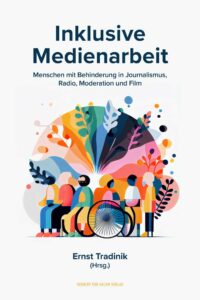 Inclusion – a buzzword that is becoming ever more present in a media context, too. When, for example, Austria’s largest charity format is criticized on public service television (»Licht ins Dunkel« ) or the mass media report very generally on people with disabilities in various program formats, the buzzword ›inclusion‹ is an essential component. But this belies the actual situation – inclusion in Austria and Germany remains a major work in progress.
When it comes to representation in mass media, people with disabilities remain highly underrepresented. Often, the mass media fall back on various stereotypes (»victim« vs. »hero« ), rather than reflecting people’s lived reality or creating an equal footing (cf. MediaAffairs 2016). And it remains much too rare for people with disabilities to work as journalists or media-makers themselves. This is particularly true of people with learning difficulties (described in the book as a »learning disability,« outdated: »people with mental disability« ) and people with experience of psychiatric treatment.
Inclusive media work can play an important role in pushing through positive change processes. Access to media, media representation on an equal footing, and the opportunity to make media themselves redistributes power a little and makes participation with equal opportunities more realistic. It allows people with disabilities themselves to (help) decide which topics are covered, and to influence their representation. Inclusive media work can make a significant contribution to (self-)empowerment, as Ernst Tradinik explains.
He is the editor and »main author« of the book Inklusive Medienarbeit. Menschen mit Behinderung in Journalismus, Radio, Moderation und Film, published in 2024 by Herbert von Halem Verlag. He himself spent many years as a support and social education worker – experience that he brings to the book in many places, often in the form of anecdotes.
Tradinik has subdivided the book into five sections. The first section centers around the question: »What is inclusive media work?« This includes outlines of segments of this field of work: What can supporters do in order to work inclusively? (»Integration and participation«) Which technical aids can support this? Section two provides »Insights into the history of inclusion and inclusive media work.« This section contains a collection of very different texts. In one of them, Cornelia Pfeiffer, a self-advocate, uses simple language to describe life in residential homes. Descriptions of experiences and biographical accounts like this are essential for inclusive media-makers. Addressing these topics (including first-hand) is the only way to clearly depict the dimensions of societal exclusion and many power-specific aspects. The fourth and fifth sections describe different media (projects), initiatives and actors in the inclusive media field. Numerous QR codes make it easier to use the links.
It is positive that the editor always refers back to the complex question of power and the necessity of reflecting on one’s own position. He calls on the reader to question whether inclusion can really be spoken of: »How do I respond to people? How do I actually deal with them? This is one of the most difficult areas. Because of course everyone wants inclusion and puts it into practice. Everyone would say that. It is in part so difficult because inclusion cannot be measured. It is often about (subconscious) questions of power. Yet one still needs to address how a certain quality standard can still be upheld« (20).
In some places, content remains vague; the book appears unstructured and erratic. Tradinik defines inclusive media work as follows: »Inclusive media work means electronic (radio, video and similar) media work by and with people with (learning) disabilities and/or psychological illness. With or without support from experts in (social) education, communication studies or similar (media) fields« (30). This very broad definition remains imprecise on the aspect of inclusion. It does not take into account how exactly the process of inclusive media work (participation and power relationships) should look – in short: When is media work really inclusive? Although the topic of participation is mentioned, it is not dealt with in more detail until later. The way the media projects are presented is more like a glossary and contains texts directly copied from websites in places. Media educator Anja Thümmler (among other authors) gives instructive insights into practice. She writes of the media work of »Radio Inclusive« and about how an equal footing can be created. In doing so, she addresses central points and barriers, such as that »many interview guests, even those who work in the field of ›inclusion,‹ are unable to speak simple language. They sit opposite radio editors or journalists with learning disabilities, are asked a question, and answer it in a way that their counterpart cannot understand« (242).
It is a shame that no summary in easy language is included with the chapters, especially given that the book repeatedly reflects on its importance for people with learning difficulties. This may be because the book is aimed at (potential) supporters without disabilities.
The book elaborates in an enriching way on the significance of (inclusive) media work for people living in institutions, and demonstrates the effects that this has on their self-image and the associated self-empowerment. Indirectly, Inklusive Medienarbeit also makes clear that inclusion is still far from being implemented in the German-speaking media world. »Inclusive media projects« are still dominant in the field; participation in (paid) media work in established mass media, as a deskman or presenter, remains a rarity. It would have been desirable for the book to address this in more detail.
The UN Convention on the Rights of Persons with Disabilities obligates its signatory states to grant people with disabilities comprehensive participation in all areas of life. It states that people with disabilities are members of society with equal rights and have a right to inclusion. In order to embed and implement this understanding, (barrier-free) access not only to media, but also to the associated professions, is essential. Editorial offices at established media therefore need to work on inclusive media work. Inclusion is a matter for us all.
About the reviewer
Hannah Wahl works as a screenwriter and journalist in Vienna. In 2023, her book Radikale Inklusion [Radical inclusion] was published by Leykam Verlag. As co-founder of the Mabacher Award film prize, she advocates inclusion through films and inclusion in films.
References
Bundesministerium für Soziales, Gesundheit, Pflege- und Konsumentenschutz (BMSGPK) (ed.): UN-Behindertenrechtskonvention. Deutsche Übersetzung der Konvention und des Fakultativprotokolls. 2016. https://broschuerenservice.sozialministerium.at/Home/Download?publicationId=19
MediaAffairs: Menschen mit Behinderungen in österreichischen Massenmedien. Jahresstudie 2015/2016. 2017. https://www.rtr.at/medien/aktuelles/publikationen/Publikationen/Studie_Menschen_mit_Behinderung.de.html
Translation: Sophie Costella
This review first appeared in rezensionen:kommunikation:medien, 4 March 2025, accessible at: https://www.rkm-journal.de/archives/25375
About the book
Ernst Tradinik (ed.): Inklusive Medienarbeit. Menschen mit Behinderung in Journalismus, Radio, Moderation und Film. [Inclusive media work. People with disabilities in journalism, radio, presenting and film.] Cologne [Herbert von Halem] 2024, 432 pages, EUR 37