
![Ingrid Brodnig, Florian Klenk, Gabi Waldner, Armin Wolf (eds.)(2024): Praktischer Journalismus. Ein Lehrbuch für den Berufseinstieg und alle, die wissen wollen, wie Medien arbeiten. [Practical journalism. A textbook for career starters and anyone who wants to know how the media work.]](https://journalistik.online/wp-content/uploads/2017/10/cropped-journalistik-hintergrund-groß.png)
Reviewed by Gabriele Hooffacker
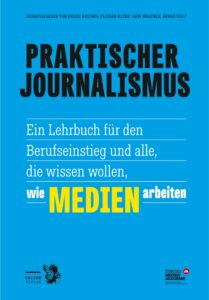 Sometimes you just have to break the mold. The Austrian textbook Practical journalism does so by moving beyond its great role model and forebear by Heinz Pürer to compile and curate a completely new work, according to its editors.
Starting with the structure of the book, their new concept is self-evident: Beginning with the basics (what is journalism – and what isn’t), the textbook covers the classic beats (from foreign policy to local news to science), news genres (from news to editorial work), »digital journalism« (from social media to podcasts to artificial intelligence) and journalism as a profession (ethics, media law, labor law, journalistic entrepreneurship).
Perhaps it is precisely because of this break with tradition that Andreas Koller, deputy editor-in-chief of the Austrian daily paper Salzburger Nachrichten, first takes readers back to 1983 before outlining the changes and challenges facing (local) journalism today. A compact excursion into the history of journalism (Armin Thurnherr) is followed by an overview of sources and news factors (Alexandra Föderl-Schmidt). What distinguishes this anthology is that Andreas Koller invokes and expands the gatekeeper function of journalism (p. 15), while Alexandra Föderl-Schmidt questions it (p. 27) – accurately reflecting the current fractures and contradictions in journalism.
Overview articles on the various beats, shaped by the perspectives of the respective authors, are followed by a chapter on journalistic genres. Some of these are genuine »how-to« articles that are useful reading for those starting out in the profession. Yet, whether »satire« is a genre or rather a stylistic device is a matter up for debate.
The decision not to separate journalistic genres by media channel leads to duplication, but still makes sense: a written portrait (Christa Zöchling) brings different challenges than an audio portrait (Eva Rother). In the chapter on written interviews it is suggested that they are still transcribed by hand (Renate Graber) – with no mention of speech-to-text tools. In turn, such tools are offered by Christina Elmer in her contribution on AI in the next chapter.
The volume devotes a separate chapter to digital journalism, which wisely refers back to articles on journalistic genres. The section on online journalism (Gerold Riedmann) remains general, but practical tips are then provided in the article on »Multimedia Presentation Formats« (Elisabeth Gamperl). The article on data journalism encourages readers to engage with numbers (Martin Thür / Jakob Weichenberger), while Ingrid Brodnig describes the challenges of fact-checking, after briefly introducing the topic of online research for image and video forensics earlier in the book.
The chapter »Journalism as a profession« begins with an insightful contribution on editorial management (Martin Kotynek) and then moves on to journalistic ethics (Wolfgang Wagner) and legal issues (Maria Windhager) as well as labor law (Andreas Schmidt/Verena Weilharter) and personal branding for journalists (Richard Gutjahr). The volume concludes with two articles on career paths (Nikolaus Koller) and the media landscape in Austria (Harald Fidler).
The articles vary considerably in terms of tone and presentation. One author (Katharina Schell) provides few references but makes extensive use of footnotes, while another one (Armin Wolf) lists practically all relevant literature on the subject. And sometimes there are simply lists of links (Jonas Vogt) – these quickly become outdated and are impractical to type.
Due to the large number of authors, the tone of the volume varies. Sometimes a collective »we« is invoked when describing ideal behavior in journalism, while at other times the reader is addressed directly with an informal »you.« In the chapter on genres, however, the formal form of »you« in German is used throughout the text. Editorial guidelines in the form of a style book could be helpful here.
On multiple occasions, whether in the first chapter on investigative journalism or on the topic of domestic politics, the influence of PR activities by political parties and companies is clearly illustrated and the need for smart counter-research by experts emphasized. By and by, these mosaic pieces form the picture of an Austrian media landscape with powerful media outlets on the political right, making the case for a country in dire need of good journalism.
When holding the book up against its title and claim (»A textbook for career starters and anyone who wants to know how the media work«), it can be concluded:
- »a textbook«: sometimes presented as a narrative, sometimes as practical advice
- »for career starters«: sometimes offering fundamental insights, sometimes individual reflections
- »for anyone who wants to know how the media [in Austria] work«: a resounding yes – what a great read!
About the reviewer
Gabriele Hooffacker is co-editor of Journalism Research and teaches at Leipzig University of Applied Sciences (HTWK Leipzig). Hooffacker edits the textbook series »Journalistische Praxis«, founded by Walther von La Roche (1936-2010) and published by Springer VS. Contact: g.hooffacker@link-m.de
References
Hooffacker, Gabriele; Meier, Klaus (2017): La Roche’s Introduction to Practical Journalism. 20th ed. Wiesbaden: Springer VS.
Pürer, Heinz; Rahofer, Meinrad; Reitan, Claus (eds.) (2004): Practical Journalism: Press, Radio, Television, Online. Includes CD-ROM with journalistic examples. 5th ed.Konstanz: UVK.
About the book
Ingrid Brodnig, Florian Klenk, Gabi Waldner, Armin Wolf (eds.)(2024): Praktischer Journalismus. Ein Lehrbuch für den Berufseinstieg und alle, die wissen wollen, wie Medien arbeiten. [Practical journalism. A textbook for career starters and anyone who wants to know how the media work.] Vienna: Falter Verlag 2024, 264 pages, EUR 29.90