

Reviewed by Tanjev Schultz
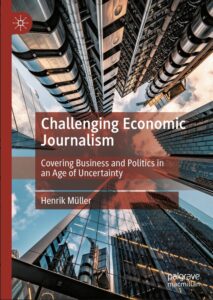
As important as business journalism is, it receives little attention in academia. At least compared to political reporting, it’s striking that journalism research doesn’t pay much attention to the business section. The situation is similar in education and textbooks. There are, however, a few notable exceptions. One is the degree program in economic journalism at the TU Dortmund University, led by Henrik Müller, former deputy editor-in-chief of manager magazin and now professor of economic journalism. In a recent English-language book, Müller formulates standards for business journalism and explores the specific challenges facing this field.
The book links central research questions and key study findings directly to journalistic practice – an exemplary bridge between journalism and journalism studies, one that Müller himself personifies. Complex topics are presented in an accessible manner, while pressing questions are raised and answered: What role should business journalism assume? Which »narratives« dominate reporting, and which issues are systematically overlooked by the media?
Müller outlines the history of business journalism, presents a helpful taxonomy, and discusses quality criteria. His standards are rightly high and meeting them is certainly not easy: »We are dealing with particularly complex and abstract issues. The key-audience of professional users demands relevant issues to be covered not just in a factually correct, but also in a forward-looking manner. Economic journalism is confronted with a wide range of powerful interests that try to influence the media in their favour.« (p. 57)
Müller, who still works as a business journalist and contributes as a columnist to Der Spiegel’s online edition, writes about editorial practices with critical distance, though never in a detached manner. Several chapters open with concise accounts of his own professional experiences. One such episode recalls a meeting at the Bundesbank (Germany’s central bank), where Müller was struck by how strongly some colleagues identified with the very subjects they were covering: »[J]ournalists should lean against the wind by challenging popular economic narratives« (p. 106).
The author proposes a normative model for economic journalism, encapsulated in the so-called ESSF formula: efficiency, stability, sustainability, and fairness (p. 64). According to Müller, whenever the formula – or any of its four dimensions – is disregarded or violated in economic practice, this should trigger critical journalistic scrutiny. Efficiency requires that economic resources not be wasted; as he puts it, »the more income and growth the better, all things being equal« (p. 64). The additional criteria, however, ensure that the model is neither naïve nor reducible to a radically neoliberal program: »Stability entails the absence of erratic movements of markets that obstruct their smooth functioning and may lead to economic and social disruptions. Sustainability purports that the destructive overuse of natural resources is undesirable, as it leads to future scarcities. Fairness rules out exploitation and overreach of any kind resulting from the asymmetric distribution of wealth, power, or information.« (p. 64)
Müller could have elaborated more extensively on how his formula relates to different schools of economic thought, and on how media organizations – whose editorial orientations are often aligned with one of these schools – might avoid or at least mitigate ideological bias. Maybe the book could also have addressed in more detail the ethical pitfalls and various codes that exist in business journalism more fully, even if these often only require what should be self-evident (such as avoiding conflicts of interest or refraining from using insider information for one’s own business).
Anyone who takes the ESSF formula seriously will quickly notice shortcomings in the media – just as Müller does when he criticizes, among other things, the lack of adequate reporting on international issues. Too often, global developments are either overlooked or reframed for a purely national audience. Müller himself notes that whenever he writes about the European Union in his Spiegel column, the numbers – clicks, reach, and so on – consistently fall short compared to his other articles.
Drawing readers’ attention to economic topics is no easy task.
The book discusses the role of storytelling and the importance of crafting journalistic pieces that resonate with the widest possible audience – ideally without sacrificing too much substance. However, it is not a guidebook that explains exactly how a piece should be written or filmed. Precisely because it takes a deeper approach and presents more fundamental arguments, it would be desirable for not only researchers and students, but also experienced journalists to read and be inspired by this book.
About the reviewer
Dr. Tanjev Schultz is a Professor of Journalism at Johannes Gutenberg University in Mainz, Germany. He is one of the editors of Journalism Research. Contact: tanjev.schultz@uni-mainz.de
About the book
Henrik Müller (2023): Challenging Economic Journalism. Cham: Palgrave Macmillan, 304 pages, EUR 139.09