

Reviewed by Tanjev Schultz
 What does the German public learn from the media about political and cultural events and developments in Romania or Bulgaria? Shamefully little. It takes Russian interference, annulled and rescheduled presidential elections like the recent ones in Romania – major crises, in other words – for these countries to make the news. The few German media outlets that report from Eastern and Southeastern Europe lack permanent correspondent offices there. What happens in Bucharest is monitored from Vienna.
Media ignorance of some countries prevails even when there is considerable historical, geographical, and cultural proximity to them. Bulgaria and Romania are members of the European Union, but invisible borders still run within the union. This is aptly described by the term »subalternity,« used by Martín Oller Alonso in his book. Certain regions are considered marginal, less important, less independent. This is reflected in media patterns and organizations, for example, in the power and ownership structures of Western media companies that expanded their operations to the East after 1989.
So, there are good reasons for a book that, inspired by postcolonial theory, outlines a program for the »decolonization of journalistic knowledge.« However, this is where the positive appraisal of this work by a Spanish colleague who conducts research at the University of Salamanca ends. The reviewer has learned almost nothing from the book about the Eastern European countries that were supposed to be honored in the book; almost nothing about specific media practices or content – and hardly anything tangible about the assumed colonial conditions. Instead, the text consists of often opaque abstractions, for which an astonishing number of Western (!) intellectual giants are mobilized in tiresome name-dropping.
The author’s goals seem sympathetic; he is concerned with openness, diversity, and equality. He is concerned with multipolarity and a deliberative democracy in which capitalist market forces are not confused with the common good. However, the book does not reveal where and how such normative expectations are disappointed or fulfilled; nor does it explain why they should be at odds with »Western« or »Northern« values and journalism cultures. Where does the author get his normative ideas from? Without elaborating on the exact nature of the problems, he opposes a »Euro-centric knowledge hegemony.« This goes hand in hand with the usual reservations of postcolonialism and poststructuralism against the supposedly Western concepts and understandings of subject and reason. Even those who share this perspective (unlike the reviewer, for whom universalism is not the same as colonialism) might expect the author to explain what characterizes the regional (journalistic) cultures in Eastern European countries and how they differ from their colonially imposed versions. But no – the book leaves that open.
In just a few pages, Martín Oller Alonso outlines the media landscapes in Poland, Hungary, the Czech Republic, and other Eastern European countries. These sketches do not go beyond the character of brief handbook entries, revealing little about the diversity and peculiarities of these countries – and also nothing about the destructive effects attributed to Western forces.
The text remains cloudy: »As the reader may have noticed, my alternative meta-vocabulary and (counter) narrative steer clear of any normative standpoint that aims to define the professional profile of journalists based on established European social structures. The supremacist dialectic and the language of domination and cultural imposition (as John Tomlinson emphasized during the nineties) have become stagnant, as has the notion of a superior culture. Ideological and professional isolationism has lost its meaning. Journalism and its communicative model are deeply connected to the social context in which they develop.« (41)
This openness and vagueness, however, will likely quickly be over if (media) people, whether in Western or Eastern Europe, warm to something the author finds evil, namely capitalism and forms of »European phallocentrism«(!). It would be interesting to know which model of society and journalism the people and (professional) colleagues in these countries actually desire and envision. The book, in its liberating tone, simply glosses over this.
So what are the prospects for the countries whose advocate the author sets himself up to be? This is what they should look like, whatever that may mean:
»They possess the chance to reconnect with the historical theoretical-methodological foundations and align them with the goals of a late-capitalist democratic society. The objective is to formulate a harmonious nation and a deliberative communication model that can illuminate and pass on the legacy of critical, alternative, and participative communication to future generations.« (61)
There are pages and pages of empty formulas. It is a tedious read. Exploring, appreciating, and strengthening journalism in the countries of Eastern Europe, and protecting it from Western arrogance and appropriation: That would be important and valuable. But this requires other means than this book.
About the reviewer
Tanjev Schultz, Dr., is professor of journalism at Johannes Gutenberg University in Mainz. He was a guest professor at Lucian Blaga University of Sibiu, Romania, this summer (2025). He is one of the editors of Journalism Research. Contact: tanjev.schultz@uni-mainz.de
Translation: Tanjev Schultz with help of DeepL
About the book
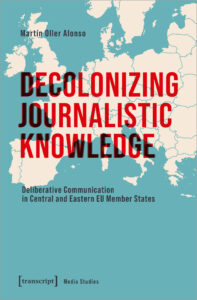
Martín Oller Alonso: Decolonizing Journalistic Knowledge: Deliberative Communication in Central and Eastern EU Member States. Bielefel [transcript] 2024, 176 pages, EUR 42