
![Maike Suhr (2026): Zwischen Repair und Care. Neugründungen als Chance für Diversität im Journalismus [Between Repair and Care. Start-ups as an opportunity for diversity in journalism]](https://journalistik.online/wp-content/uploads/2017/10/cropped-journalistik-hintergrund-groß.png)
Reviewed by Phoebe Maares
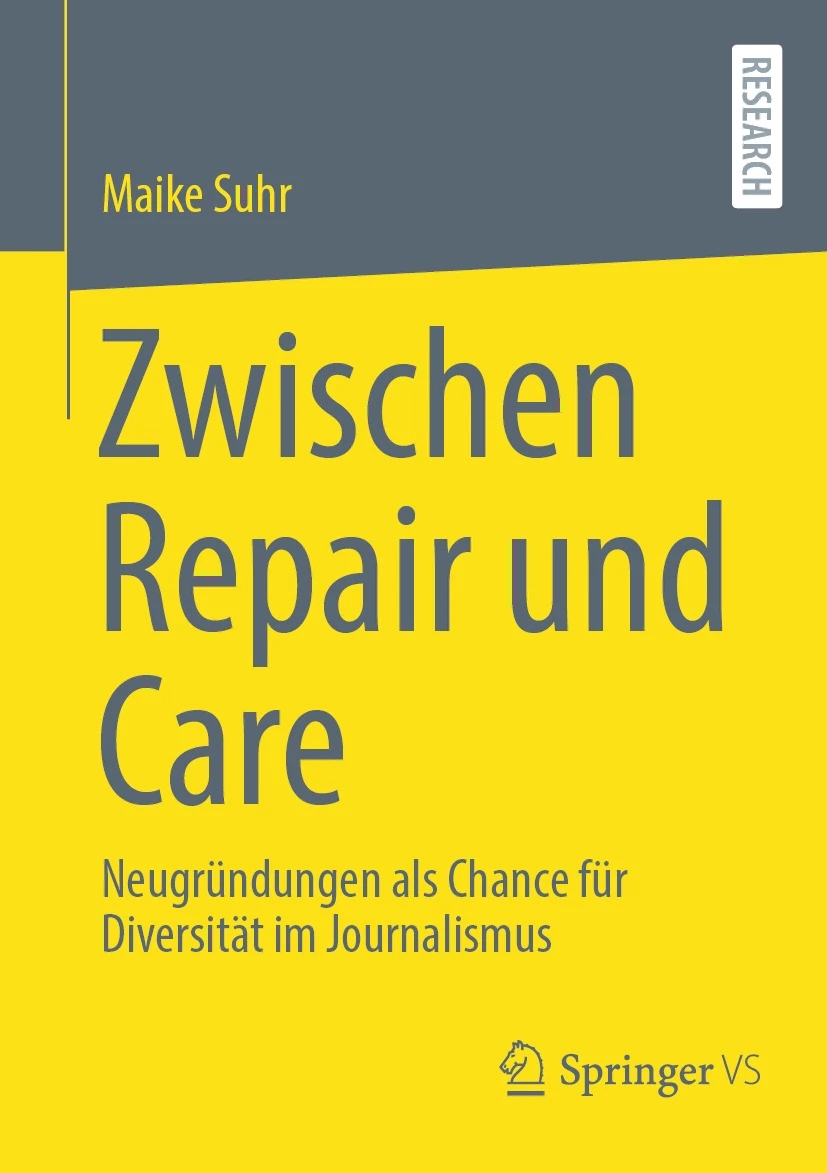 Journalism in Germany is primarily produced by white, well-educated people who have little or no experience of marginalization. Entry into the profession through low-paying internships, freelance work, and permanent positions means that one must be able to afford this career choice. How can journalism, under such circumstances, facilitate diverse perspectives in newsrooms and reporting?
In her dissertation, Maike Suhr examines new journalism start-ups as an opportunity to promote diversity in newsrooms and within journalism. In doing so, she addresses a highly topical issue and provides initial insights into the role that new journalism start-ups play in fostering diversity and overcoming inequality in journalism. With her work, she expands the body of research on entrepreneurial journalism, precarious work, and intersectional inequality studies.
Theoretically, Suhr draws on feminist and intersectional approaches as well as the concepts of diversity management and inequality, and summarizes the state of research on diversity in established newsrooms, alternative media, and new media start-ups. In doing so, she distinguishes between individual journalistic organizations’ care for their employees (»Care for Journalists«) and the promotion of equality and diversity in the journalistic field as a whole (»Care for Journalism«). She also examines the motivations behind founding new journalistic media outlets, the opportunities for growth that these start-ups offer to marginalized individuals, and how these media outlets position themselves within the journalistic field. These three perspectives also structure the presentation of the findings.
Methodologically, Suhr employs a hybrid ethnography, triangulating short observation phases at eleven start-ups in Germany and Austria with interviews and documents; the observations took place in newsrooms, coworking spaces, and digital newsrooms. Her approach also illustrates the growing difficulties researchers face when attempting to capture changing work practices in journalism: On the one hand, some start-ups are now organized exclusively in the digital sphere, which limits the observation of work organization and day-to-day collaboration. On the other hand, access to the field is complicated because start-ups – especially those with precarious organizational structures – lack the time or resources for interviews. Suhr highlights the problem that, in particular, start-ups that place special emphasis on work-life balance and want to spare their employees this extra work did not participate in the study, even though the perspectives of these organizations would certainly have contributed to an understanding of »Care for Journalists.«
The findings section of the study is divided into three parts, though the final findings chapter – the role of start-ups in promoting diversity within the field – is rather brief. Key findings point to the difficulties of embedding diversity in the field of journalism, particularly in established newsrooms: »Starting a new venture is considered easier than bringing about change in established media organizations« (p. 114). This impression is conveyed above all by founders with experiences of discrimination who have left established newsrooms to put their vision of journalism into practice. Nevertheless, measures to improve diversity, equality, and inclusion in newly founded newsrooms are not always institutionalized. This can pose risks in the long term, for example, when employees who promote and advocate for equality leave without a successor. Another key finding of the book is that the absence of hierarchies and open forms of work organization are not necessarily beneficial for marginalized journalists and can also lead to exclusion. Instead, well-thought-out strategies are needed to give everyone equal access to decision-making positions in journalism. Ultimately, according to Suhr, new media outlets contribute to diversity in the field because they foster sensitivity to marginalized issues and perspectives, complement established journalism with precisely those perspectives, and train and employ journalists from diverse backgrounds. The study shows that efforts to promote diversity are, in some cases, »outsourced« to start-ups. Nevertheless, start-ups bring a changed understanding of values to the field of journalism and normalize »journalism with a stance.«
Maike Suhr’s dissertation stands out in particular for its focus on newly founded organizations with varying levels of commitment to diversity and the elimination of inequality in journalism. This perspective highlights the potential for journalism and illustrates how deeply entrenched structures of inequality are in our society – as well as in the field of journalism – and how difficult it can be to break them down. Here, the book points out discrepancies between the claims made by founders and the actual situation: Founding an organization requires more than just an idea. The first chapter on findings, in particular, highlights the wide variety of obstacles. Furthermore, the book addresses the vagueness of the term »diversity« and thoughtfully complements it with concepts of participation, equality, inequality, and an intersectional perspective. While (German-language) journalism research has, to this day, focused primarily on gender as a category of inequality, Suhr’s approach is decidedly intersectional and examines the opportunities in journalism for people from various marginalized groups.
At the same time, the findings and the resulting theoretical analysis could go into greater depth in some places. In particular, the reader finds that insights from the observations and documentary material are lacking in some sections. Furthermore, it is unclear how many people from which organizations were interviewed and what experiences they bring from established media outlets. Here, one would like to see an overview – for example, in the form of a table – that provides this contextual information while preserving anonymity. Although the concept of power is frequently mentioned, it is not explicitly theorized, and the question of material and immaterial resources in the distribution of power is not discussed in greater detail. Here, a reference to theories from the sociology of work or the »space of journalistic work« as defined by Örnebring et al. (2018) could have added more depth to the interplay between »Care for Journalists,« power, precariousness, and financial difficulties.
Nevertheless, Zwischen Repair und Care is an important early contribution to intersectional diversity in German-language journalism. By examining start-ups, the book is also relevant for students, researchers, and potential start-up founders who are interested both in developments in entrepreneurial journalism and in broader questions of inequality, precariousness, and marginalization in journalism.
About the Reviewer
Phoebe Maares holds a PhD from the University of Vienna and is a postdoctoral researcher in the Media and Public Spheres research group at the Institute for Research on Far-Right Extremism, University of Tübingen. Her research focuses on boundary-blurring phenomena in journalism, the socio-material conditions of journalistic work, and power relations within the journalistic field, examining how these shape journalistic epistemic practices.
References
Örnebring, Henrik, Karlsson, Michael, Fast, Karin, & Lindell, Johan (2018). The space of journalistic work: A theoretical model. Communication Theory, 28(4), 403–423.
About this book
Maike Suhr (2026): Zwischen Repair und Care. Neugründungen als Chance für Diversität im Journalismus [Between Repair and Care. Start-ups as an opportunity for diversity in journalism]. Wiesbaden: Springer VS, 194 pages, 69.99 euros