

Reviewed by Stine Eckert
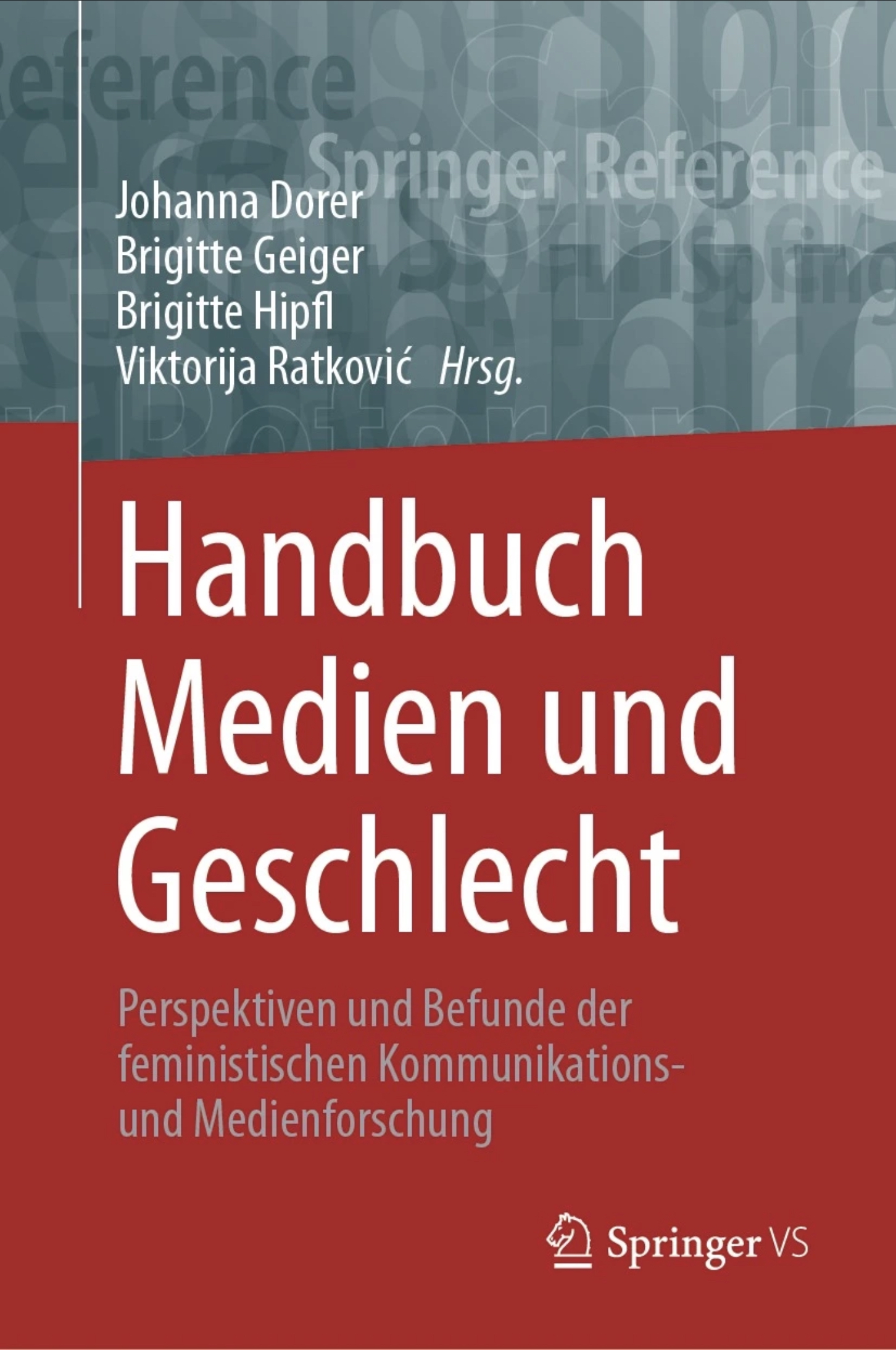
With the Handbook of Media and Gender: Perspectives and Findings in Feminist Communication and Media Research, the four editors – Johanna Dorer, Brigitte Geiger, Brigitte Hipfl, and Viktorija Ratković – have produced an impressive work. It introduces readers to German- and English-language research on communication, journalism, media, and gender in very accessible language and a well-structured format.
The book is divided into 10 sections, each containing several chapters, which begin appropriately with two fundamental overviews of theory and methodology. These are followed by two sections on media production, content, and reception, and historical media research. In five further in-depth sections, highly relevant topics in feminist-critical research are summarized and contextualized: politics and economics, women’s movements and feminist media, violence and power relations, differences, and media culture. In the final section, which is the shortest, future research questions are raised in two chapters.
In her foreword, Irene Neverla positions the handbook as another important contribution to the establishment of feminist communication and media studies in the German-speaking world and acknowledges the achievements of all those involved. The editors’ brief introduction emphasizes the focus on the German-speaking world, particularly Austria, while noting that research on Switzerland is less represented. It is therefore consistent that the list of authors locates the contributors predominantly in Austria (including the editors at the Universities of Vienna and Klagenfurt) and in West German states; only three were based at East German universities (Ilmenau, Potsdam, Rostock). This orientation is reflected in the handbook, whose vast scope includes only sporadic research on media and gender in the GDR or East Germany.
The densely written 72 chapters cover the impressive breadth and depth of feminist communication and media research. They bring together the decades-long work of pioneers and subsequent researchers in a nuanced way. Connections to the English-speaking world are also repeatedly highlighted, particularly to the U.S. and the U.K., where some research questions were previously addressed in studies. Relevant findings are then mostly limited to (West) German and Austrian contexts.
The concept of media is broadly defined here: it ranges from traditional print and broadcast media to film and art, as well as digital spaces and events such as women’s music festivals. Intersectional approaches are repeatedly emphasized, while at the same time it is noted that further research is needed on intersecting categories of identity in this field. »Part VIII: Differences and/in Media« addresses this in particular. Eight chapters summarize research on migrants in media production and content, »whiteness,« class, age, and multilingualism in relation to gender, supplemented by a contribution each on masculinity studies and media sports. Other aspects of identity appear sporadically in other chapters, such as in Waltraud Ernst’s contribution »Phenomena of Becoming: Intersectionality, Queer, Postcolonial, Diversity, and Disability Studies as Orientations for Media Research« in the theoretical section. Certainly, a selection had to be made, as other categories such as dis/ability, parenthood, sexual orientation, the body, religion, nationality, or East German/West German socialization would also have been conceivable for dedicated texts on differences. For the last category of difference, a text on the history of media and gender in the GDR – for example, on media produced by non-state women’s movements – could also have been included in »Part IV: Historical Media Research,« which contains seven chapters.
It is also noteworthy that the book’s longest chapter, at 21 pages, rightly focuses on the topic »Gender-Based Violence: Reporting, Discourses, and Feminist Interventions.« Written by Brigitte Geiger, who was a lecturer at the Institute for Journalism and Communication Studies at the University of Vienna, and Birgit Wolf, who works for the Women’s Helpline of the Autonomous Austrian Women’s Shelters in Vienna, it demonstrates how crucial the ongoing connection between feminist research and practice is for tangibly improving the lives of women and vulnerable groups: reducing violence, preventing harm, and respecting human dignity. In their conclusion, the authors propose establishing chairs and research centers on gender-based violence, a call that is understandable given the persistence and rise of gender-based violence both online and offline. »Part VII: Violence, Power Relations, and the Media« offers, in four additional chapters, a shocking inventory of gender-based acts of violence that persist, but also shows that these are no longer taboo topics; rather, they have been brought to light in diverse ways through research and the media.
Each article begins with a table of contents, an abstract, and keywords to aid in navigation. A bibliography follows each contribution. This arrangement is particularly helpful in the print edition, which contains neither a subject index nor a name index for looking up terms across chapters. However, the book is also available as an online edition, which facilitates the search for specific terms – such as big data, social media, or AI – that do not appear explicitly in the headings and subheadings. According to the editors and the publisher, the book has been designed as a »living reference work.« This allows chapters dealing with rapidly evolving trends – such as those driven by technologies like artificial intelligence, large language models, or computational methods – to be updated and expanded. According to the publisher, this will begin in 2027. The online edition is also well-suited for use in teaching, where individual chapters can serve as an introduction to topics or as an overview or review for students and instructors. The online version is also available in English, thereby making an important contribution to making German-language studies and research lines more accessible in the English-speaking world.
The book’s strengths lie primarily in the wealth of studies that each contribution discusses within a disciplined structure, in order to explain foundational and major works in greater detail and to present other important studies more thoroughly. This brings research trends, conflicts, and divergent approaches to light and situates them within the current state of the field. Various definitions of key concepts are discussed, making the contributions particularly well-suited for familiarizing oneself with new research topics in the feminist field. It is noticeable, however, that the publication dates of the most recently cited studies vary somewhat in terms of their recency, which is certainly due to the long period of time – seven years – during which the editors worked on this 1,031-page volume, as mentioned in the introduction.
Time and again, authors and editors alike highlight in their conclusions the academic conditions for Gender Media Studies, which, while having become institutionalized, have in some cases lost touch with women’s movements. This is because universities operate as »business entities that are guided by management criteria and key performance indicators, and that engage in metric-based performance measurement and indicator-driven management of research and teaching« (p. 1025). Thus, on the one hand, the handbook bears witness to the success of Gender Media Studies in opening up spaces within academic structures to conduct methodologically and theoretically innovative research and to influence communication and media studies. On the other hand, it also repeatedly reveals a history of constant justification and struggle by and for marginalized groups, a history that is by no means over. In this regard, the penultimate chapter by Susanne Lummerding on the topic of »power- and discrimination-critical professionalization of knowledge production« is a valuable contribution to inspiring further courses of action. »We must therefore actively work to ensure that academia and its institutions become an inclusive space for critically questioning power and for solidarity-based, critical engagement for all« (p. 1015).
This also applies, in a modified form, to newsrooms that must navigate multiple transformations, for which the handbook Media and Gender offers a valuable treasure trove of knowledge. Journalists and media professionals can find useful guidance in it for their reporting and editorial processes and formulate inquiries to scholars on the topic of gender and media more precisely. Editorial offices should definitely have this book on their shelves to build upon the current state of research. Furthermore, as an indispensable compass, the handbook should by no means be missing from the book collections of institutions and researchers in feminist communication and media studies.
About the Reviewer
Stine Eckert is an associate professor in the Department of Communication at Wayne State University in Detroit and co-editor of Journalistik/Journalism Research.
About this book
Johanna Dorer, Brigitte Geiger, Brigitte Hipfl, Viktorija Ratković (eds.) (2023): Handbook of Media and Gender. Perspectives and Findings in Feminist Communication and Media Research. Springer VS, 1,031 pages, 129.99 euros