
![Georg Fülberth (2026): »…dem liberalen Schwindel ein Ende zu machen«. Karl Kraus und Wilhelm Liebknecht 1899/1900 [»…to put an end to the liberal sham.« Karl Kraus and Wilhelm Liebknecht 1899/1900]](https://journalistik.online/wp-content/uploads/2017/10/cropped-journalistik-hintergrund-groß.png)
Reviewed by Horst Pöttker
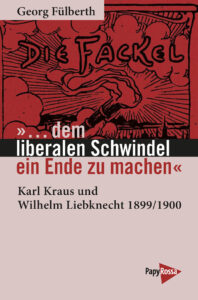 Georg Fülberth, one of the perennial leftists in German social and political science, a student and successor to Wolfgang Abendroth in Marburg, initially a member of the SPD [Social Democratic Party] and later of the DKP [German Communist Party], continues to publish remarkable works on »capitalism« – as he calls his interdisciplinary field of research – despite being 86 years old. His latest book is devoted to the one-year journalistic collaboration between Wilhelm Liebknecht – the editor-in-chief of the SPD’s central organ Vorwärts, who died unexpectedly in August 1900 at the age of 74 – and the 25-year-old Viennese journalist Karl Kraus, who had just founded his magazine Die Fackel, in which he would go on to satirize the liberal press – both rhetorically and politically – for the next 36 years, as virtually its sole author.
Both journalists have often been accused – by Hannah Arendt, among others – of having sided against the Jewish officer Alfred Dreyfus, who had been exiled to Devil’s Island for years, against their better judgment, even after his innocence had been proven and the anti-Semitically motivated miscarriage of justice against him had been exposed and denounced in the press by Émile Zola and others. Fülberth’s argument primarily seeks to refute this accusation, even though he does not state this explicitly; rather, he merely attempts to explain the stance of the two famous editors.
Fülberth’s book is clearly and intelligently structured. It begins with a thesis, the reasoning behind which forms the central thread running through the book:
»How did it come to pass that Karl Kraus, whose ›Fackel‹ repeatedly attacked social, cultural, and political injustices, and the socialist Wilhelm Liebknecht behaved in this way? Was it perhaps not at all about Alfred Dreyfus, democracy, and the rule of law, but – one layer deeper – about the state of bourgeois society and public opinion within it? This question is also a hypothesis. It is hereby posed and will be examined in the following sections on the basis of the sources.« (p. 7)
This is followed by a review of the research (pp. 8–15) and then, in chronological order, ten chapters on the development of the relationship between the two editors (pp. 15–118). Essentially, this relationship consisted of Kraus publishing a series of agreed-upon articles written by Liebknecht in Die Fackel; and of Kraus asking Liebknecht – with little success – to also comment in these articles on the policies of the socialist parties in Germany and Austria. The book concludes with an analysis of the case in the context of conservative (Kraus) and socialist (Liebknecht) critiques of liberalism (pp. 119–124) and a list of sources consulted (pp. 125–131).
Fülberth explains that the two dissimilar journalists were unwilling to publicly acknowledge Dreyfus’s innocence because of their – despite all their differences – shared anti-liberal stance and agenda. They were not concerned at all with the fate of Dreyfus as a person, but rather with criticizing the political and journalistic forces that had championed him. According to Fülberth, this criticism was aimed above all at the fact that the vocal commitment of the liberal press and political circles to Dreyfus diverted attention from the actual socioeconomic problems. Kraus, for his part,
»was decidedly not interested in the question of whether the convicted captain was guilty or innocent. He was concerned exclusively with his fight against the liberal press. Even if their advocacy against a miscarriage of justice was justified in this case, it would be implausible because it was the cause of discredited newspapers.« (p. 29)
As for Liebknecht:
»In his ›Fackel‹ article, Wilhelm Liebknecht assessed the Dreyfus affair largely in terms of the objective political function of the campaign. Here he agreed with Kraus’s aside that any victory for the Dreyfusards would come at a ›high price‹ in the form of ›two years of unrest in the country,‹ […] and, moreover, through a strengthening of German nationalism.« (p. 31)
Fülberth shows that Kraus and Liebknecht’s lack of interest in a gross injustice against a Jewish individual should not be interpreted as a sign of anti-Semitism on the part of these two famous journalists, even if the injustice in this case stemmed from widespread anti-Semitism. However, it does attest to their willingness to disregard individual human rights in pursuit of political and ideological goals. Fülberth implicitly concurs with this view by explaining this disregard as an expression of an understandable anti-liberal stance, without criticizing it.
Kraus and Liebknecht’s indifference at the time to the question of Dreyfus’s guilt or innocence is mirrored by author Fülberth’s current indifference to the evidence of Dreyfus’s innocence that had already been published at the time. Referring back to 1899, the year of collaboration between the two editors, Fülberth writes:
»There was neither a confession nor conclusive evidence of Dreyfus’s guilt or innocence, only circumstantial evidence. […] Liebknecht concluded that this evidence did not point to Dreyfus’s innocence, which is why he did not ›believe‹ in it – any more than he believed in his guilt.« (p. 30)
As early as 1898, Jean Jaurès, the leader of the French Socialists, had presented compelling evidence of Dreyfus’s innocence in a book that compiled his previous articles from the socialist newspaper La Petite République.[1] It is possible that Wilhelm Liebknecht was unaware of this book the following year. But Fülberth could have been aware of it, especially since it is referred to in detail in the 2005 German translation of a book published in France in 1935 by the French Socialist Prime Minister Léon Blum, who witnessed the Dreyfus Affair as a young lawyer.[2] Fülberth did not take these two sources into account – perhaps because he was unaware of them, due to the cultural divide between Germany and France that still persists. In any case, they show that Jaurès fought publicly for Dreyfus’s rehabilitation not because of a political constellation, as Fülberth suggests, but because he had clear evidence. Léon Blum considered Jaurès’s newspaper articles and book, alongside Émile Zola’s famous »J’Accuse,« to be the key journalistic contributions that brought about the turnaround in the affair in Dreyfus’s favor in 1898.
Unlike the politically counterproductive disregard for facts, a different perspective on the journalism surrounding the Dreyfus Affair might have raised the question of why it is so rare for liberal journalism to actually deliver on the promise often attributed to it when it is referred to as the »fourth estate«: namely, to expose abuses and missteps by those in power and bring about their redress. Aside from the Dreyfus Affair, Watergate perhaps comes to mind as another truly significant case; for Germany, however, it is difficult to find such examples. One explanation is that for journalism to expose gross abuses of power that shake the pyramid of power, a rare combination of several conditions is required – such as the clear recognizability of misconduct, the independence and diversity of the media, and the determination of both the public and those responsible to act, etc. – a combination that, exceptionally, was present in the case of the Dreyfus Affair.[3] This would constitute a critique of the liberal press, one that might potentially help strengthen its weak investigative power.
Ignoring factual issues – including grammatical ones, which, owing to the publisher’s lack of proofreading, have been overlooked disturbingly often – in favor of supposedly reasonable politics or convictions does not achieve this. We are quick to attribute such nonchalance toward facts to authoritarian rulers like Donald Trump and his ilk. Fülberth’s thoroughly informative book unfortunately shows that even intelligent leftists are not immune to this.
About the Reviewer
Horst Pöttker, born in 1944, is a retired professor of the theory and practice of journalism at the Technical University of Dortmund and co-editor of Journalistik/Journalism Research.
About this book
Georg Fülberth (2026): »…dem liberalen Schwindel ein Ende zu machen«. Karl Kraus und Wilhelm Liebknecht 1899/1900 [»…to put an end to the liberal sham.« Karl Kraus and Wilhelm Liebknecht 1899/1900]. Cologne: Papyrossa, 131 pages, 14.90 euros
Footnotes
1 Jaurès, Jean (1898). Les Preuves. The Dreyfus Affair. La Petite République.
2 See Blum, Léon (2005). Summoning the Shadows. The Dreyfus Affair. Berenberg, pp. 88–92.
3 See Pöttker, Horst (2008). »The Public Sphere as a Seismograph? On the Conditions for the Media’s Role in Exposing Scandals, Using the Dreyfus Affair as an Example.« In Heinz Bonfadelli, Kurt Imhof, Roger Blum, & Otfried Jarren (Eds.). The Changing Seismographic Function of the Public Sphere. VS Verlag, pp. 57–79.