

By Janis Brinkmann
Abstract: Against the backdrop of an integrative conceptual framework, this article examines the perceptual and impact potential that explicitly subjective journalism holds for young audiences. In two experiments, a total of 273 young media users aged 17 to 28 were shown both traditional and explicitly subjective reportages on the same topic. This was followed by a standardized online survey and in-depth semi-structured interviews. The findings show that subjective journalism is perceived as more narrative and emotionally engaging, but also as less informative, less reflective, less relevant, more in need of explanation, and less critical than more objective forms. In addition, young media users identify opinions and attitudes more clearly. They would like to see more subjective content and would also comment on it more often on social media, which points to the participatory potential of subjective journalism.
A reporter who collects deposit-return bottles to experience firsthand how difficult life on the streets can be. A reporter who was bullied during her school years and later confronts her former tormentors with her feelings in a reportage. Reporters who present topics such as migration, social justice, climate change, or political extremism from a personal perspective and draw on their own experiences, expectations, and emotions to tell a journalistic story from a first-person perspective. Forms of subjective journalism are found not only in »presenter reportages«, as produced by Germany’s public-service content network »funk« in formats such as STRG_F or follow me.reports (Drössler, 2021; Brinkmann, 2023), but are also part of a subjective turn in journalism, characterized, for example, by the personalization and emotionalization of journalistic content, working practices, and forms of presentation (Smeenk et al., 2024, 2524f.).
Subjectivity in journalism is by no means a new phenomenon. From the political subjectivity of the party press, through the existentialist subjectivity of New Journalism (Pauly, 2014), to the fragmented subjectivity of social media (Steensen, 2017, pp. 31–39), subjective perspectives have a long tradition in journalism. As a »personal, individual view of the world« (Neuberger & Mayer, 2026, p. 2) – and thus as a complement to an »objective,« that is, collective, intersubjectively negotiated, verified, and socially shared perspective – subjectivity influences all dimensions through which journalists perceive and convey reality (Meier, 2018a, p. 202). Journalistic subjectivity therefore shapes topics in cultural journalism (Chong, 2019), forms such as reportage and commentary (Haller, 2020; Schultz, 2021), reporting patterns such as narrative journalism (Lindgren, 2017) and investigative journalism (Wahl-Jorgensen, 2013; Harbers, 2016), channels and platforms such as podcasts (Schlütz, 2020) and social media (Savinova & Hoek, 2025), and, as a dominant perspective, subjective journalism itself (Brinkmann, 2025a).
1. Explicit subjectivity in practices and products
Subjective journalism is understood here as a form of journalism that explicitly emphasizes journalistic subjectivity in both practices and products and uses the first-person perspective to integrate journalists’ personal expectations, experiences, emotions, and opinions into reporting. This definition aligns with the concept of personal journalism (Smeenk et al., 2023; 2024; 2025; 2026), which likewise places journalists’ personal subjectivity (»byline subjectivity«; Steensen, 2017, p. 30) at its center. Such subjective journalism, produced particularly by new media organizations (Buschow, 2018) such as Vice, BuzzFeed, and funk (Stringer, 2018; Tandoc, 2017; Dennis & Dias-Sampaio, 2021; Drössler, 2021; Brinkmann, 2023) for young audiences and distributed via social media platforms, stands in striking contrast to traditional information and news journalism, which is guided by normative ideals such as neutrality, balance, distance, and objectivity (McNair, 2017; Raeijmaekers & Maeseele, 2017; Maras, 2013; Schudson, 2001). Against this backdrop, Keinert, Heft, and Dogruel (2019, p. 171) characterize the return of journalistic subjectivity (Steensen, 2017; Smeenk et al., 2024) as a central future trend in journalism: »The illusion of objective journalism is being replaced by journalism with attitude and personality« (see also Meier et al., 2025, pp. 54–55).
So-called »objective« reporting is increasingly met with rejection by audiences, particularly with regard to socio-political issues such as climate change, migration, and social justice. This trend is also reflected in growing news fatigue and news avoidance (Newman et al., 2025; Behre et al., 2025). As an alternative to established »objective reporting« (Meier, 2018a, p. 195), not only have constructive approaches emerged that emphasize solutions to societal problems (Brinkmann, 2024a, pp. 273–277), but forms of subjective journalism have also developed that aim to transparently integrate journalists’ personal evaluations, attitudes, and opinions into reporting, thereby contributing not only to informing audiences but also to their orientation and entertainment. Young media users particularly appreciate authentic journalistic subjectivity (Harbers & Broersma, 2014; Wang & Ni, 2025) when it is conveyed through emotional, empathetic, or engaged perspectives (Mellado & Gajardo, 2026; Uth, 2025).
In light of an »emotional turn« in journalism (Wahl-Jorgensen, 2020), which Lechler (2020) argues should be analyzed from the perspective of reception and effects research, a growing body of international journalism studies is examining the consequences of immersion and emotion for audiences (Pajnik, 2023; Goutier et al., 2021; Greber et al., 2023a; 2023b). However, the question of how media users perceive explicitly subjective journalism and how it affects them remains underexplored. Guided by the overarching research question, How does subjective journalism work?, and drawing on the current state of research, this article first outlines a conceptual framework for analytically capturing subjective journalism (Chapter 2) and operationalizing it for empirical analysis (Chapter 3). It then presents and discusses the findings of an experimental study among young media users (Chapter 4) and situates the perceptual and impact potential of subjective journalism at the micro-, meso-, and macro-levels (Chapter 5).
2. Theoretical framework: the 4P model for analyzing
journalistic concepts
Building on the definition introduced above, subjective journalism is initially understood here as more subjective journalism – that is, as a multifaceted subjectivization of the journalistic programs, practices, and products of the standard model of information journalism (Evers et al., 2021, p. 456), and thus as a complement to objective journalism (Brinkmann, 2025a, pp. 198ff.).
In German-language scholarship on journalistic concepts, forms, and reporting patterns, this relationship has repeatedly been described: alternative patterns and concepts such as narrative journalism, investigative journalism, advocacy journalism, and constructive journalism (Brinkmann, 2024a, pp. 79–86) developed in response to the »weaknesses of ›objective‹ journalism« (Meier, 2018a, p. 195) and complement rather than replace it (Weischenberg, 1995, pp. 113ff.; Meier, 2019, p. 106; Wyss & Keel, 2010, pp. 362f.; Fink, 2016, pp. 9–12; Greck & Kössler, 2013, p. 109; Hohlfeld, 2003, pp. 232f.).
Subjective journalism, however, should not be understood as merely another reporting pattern but rather as one journalistic concept among multiple journalisms and, analogous to Haas’s concept of Empirical Journalism, as a »broader concept« (Haas, 1999, p. 15). Subjective journalism gains contour through the adaptation of its journalistic work programs (Evers et al., 2021) – that is, through »additional patterns of research, presentation, and staging« (Hohlfeld, 2003, p. 232).
Hohlfeld (2003, pp. 230f.) therefore characterizes it as a »counter-concept to detached information journalism and its rational approach to reality«: emotions instead of facts, storytelling instead of news values, »personal immersion in the story and emotional engagement with protagonists«, authentic language, and an insider perspective (»insider reportage«) combine narrative subjectivity with other elements such as activism, passion, advocacy, and participation, creating what Hohlfeld describes as a somewhat diffuse mélange (Hohlfeld, 2003, p. 231; see also Bleicher & Pörksen, 2004, as well as the debate on fictionality in journalism between Reus, 2019, and Schultz, 2019). Given the speed and frequency with which new forms of journalism are currently emerging and differentiating in practice (Loosen et al., 2020), it seems appropriate to regard forms and concepts of journalism as assets that ought to be analyzed and understood (Keinert et al., 2019, p. 174; see also Jarren, 2015, p. 121).
To analytically capture subjective journalism as an alternative journalistic concept that has so far remained not sufficiently defined (see Neuberger & Mayer, 2026, pp. 1–2), the 3P model provides a useful framework. It breaks down new journalistic concepts currently emerging in practice into three dimensions that influence one another but are analytically separated here in order to capture these »liquid« forms of journalism (see Brinkmann, 2024a, pp. 57–62; 2025a, pp. 782–787). From the structurally shaped level of journalistic programs for the construction of social reality, through the actions of journalists embedded in journalistic practices, to the concrete (performance) potentials of journalistic products, the model offers a way of conceptually differentiating new forms of journalism[1]. In line with the research question pursued here, it can also be expanded by a fourth dimension: audience expectations (see Figure 1).
Figure 1
Three- or four-dimensional model for conceptualizing forms of journalism
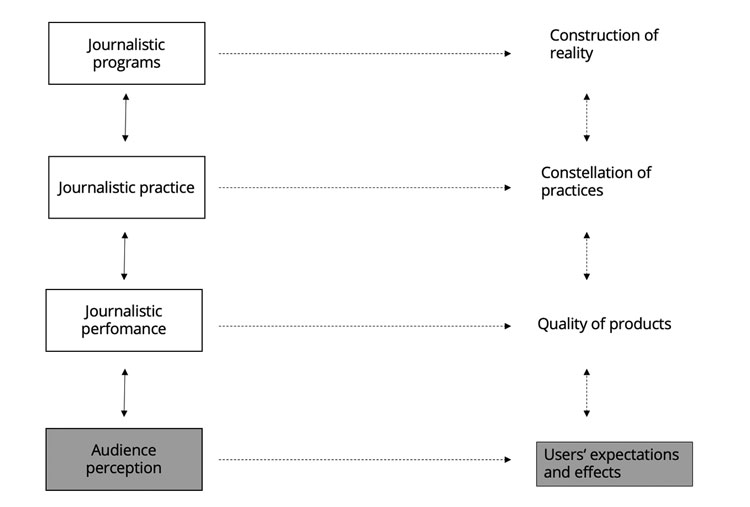
Journalism as program, practice, performance, and audience perception (adapted from Brinkmann, 2024a)
Journalistic programs: Topics, reporting patterns, genres and media channels (see Meier, 2018a, p. 202) constitute the overarching framework of relevance for every form of journalism. As »construction programs«, they are central to journalism’s construction of reality (see Brinkmann, 2025a, pp. 198–228).
Journalistic practices: Selection, research, verification, narration (storytelling), presentation, publication, and interaction are journalistic patterns of action (practices) that journalists follow by drawing on specific rules and resources within the practice constellation shaped by the respective program (see Buschow, 2018, pp. 119–125). They therefore represent the individual steps involved in the journalistic production of content (see Brinkmann, 2025a, pp. 229–245).
Journalistic performance: In addition to economical demands and ethical norms, the broad repertoire of quality criteria – such as relevance, timeliness, exclusivity, and contextuality (see Reineck, 2024) – is weighted differently across different forms of journalism, thereby generating specific performance potentials in journalistic actions and products (see Brinkmann, 2025a, pp. 246–263).
Audience perceptions: If, following Hall (1999), journalism is understood as a form of media communication, the dimensions of reception, perception, and use remain missing after the production and distribution of media content (see Buschow, 2018, pp. 83–84). For the purposes of this article, the model is therefore expanded by a fourth dimension (thus becoming the 4P model), which integrates users’ expectations and perceptions: How does the audience perceive the products of a particular form of journalism, and how do these contents affect media users?[2]
While the latter dimension of perception and effects in relation to subjective journalism has not yet been explored, empirical findings are already available for the first three dimensions (see Brinkmann, 2025a). As part of the research project »Journalistische Grenzgänger« (Journalistic Border Crossers; see Brinkmann, 2023), all YouTube videos published up to April 2022 by the established, explicitly subjective reportage formats Y-Kollektiv, STRG_F, reporter, follow me.reports, and Die Frage of the ARD–ZDF public-service content network funk were analyzed as case studies using content analysis.
In the reportages produced by these formats, the journalistic construction of social reality is shaped predominantly through lifeworld topics that are communicated to young target audiences in an emotionally oriented manner. Hybrid reportages combining interviews with elements of self-experiments focus primarily on individuals and social milieus. They use the interplay between reporters and protagonists to tell stories, most of which are set in major German cities, from a strongly subjective perspective. As the dominant reporting pattern, New Journalism shapes the construction of reality in these reportage formats. Under the conditions of social media, however, it has been updated for a target audience of 14- to 29-year-olds and adapted for web-video formats, for example through the active role of reporters appearing on camera or through calls inviting audiences to comment on the content at the end of a contribution (see Brinkmann, 2023; for a follow-up study on new presenter-led formats, see also Brinkmann et al., 2025).
Such a program of subjective journalism, in turn, also shapes its constellation of practices, in which established journalistic practices are reframed in a subjective way, as demonstrated by a qualitative analysis of the reportages that was complemented by semi-structured interviews with reporters and editors from the funk formats under investigation (see Brinkmann, 2025a, pp. 773–782):
Personalized topic introduction: Following the »golden minute« of a contribution, which summarizes its content through particularly dramatic scenes and striking quotations, reporters introduce the topic by establishing a personal connection to it, for example through their own experiences of bullying or alcohol consumption.
Hypothesis-driven research: Information gathering follows a hypothesis or guiding question, such as »What happens at Nazi concerts?« (STRG_F) or »Why do people want to be eaten? Inside the cannibalism scene« (Y-Kollektiv). Reporters typically pursue these questions through their own on-site observations, thereby allowing audiences to participate in large parts of the research process.
Interpretive storytelling: The reporters’ own stance – and sometimes their opinions – constitutes a central narrative element. Personal experiences and emotions are used to depict situations in a vivid and authentic way. Reflective elements (for example, concerning media ethics or feelings of being overwhelmed) can make contributions more transparent, although the reporters’ own interpretations strongly frame the research from their subjective perspective, particularly in the concluding sections.
On-camera reporting: Presentation by reporters who appear on camera and often address users directly is characteristic of this subjective form of reportage. Some formats supplement this direct mode of presentation with voice-over narration, which can be used, for example, to explain complex issues in greater depth or provide additional background information.
Repetitive interaction: Reporters consistently strive for active and personal communication and regularly encourage audience interaction through »calls to action«, for example by inviting comments or subscriptions. The discursive integration of the community – including crowdsourcing new topics, information, or protagonists – reflects the strong participatory orientation that characterizes this constellation of practices within subjective journalism.
The qualitative and quantitative content analyses likewise underscore that this form of subjective journalism can deliver different outcomes than traditional news journalism (see Brinkmann, 2025b). Quality criteria such as narrativity, authenticity, emotionality, and participation were more strongly pronounced in the majority of the analyzed subjective funk reportages than relevance, diversity (of sources), contextuality, or practical utility (see also Brinkmann, 2023, pp. 93–97; 2025a, pp. 751–770).
However, it remains an open question whether these subjective values – which were identified through content analysis of the reportages and explicitly communicated by the presenter-led formats as journalistic goals[3] – are also perceived by users. The extent to which potential perceptual and effects-related outcomes can be achieved among audiences can be examined on three closely interconnected levels (see Meier, 2018b, pp. 6, 10):
- At the micro level, users should be able to recognize a personal perspective (e.g., through journalists’ attitudes and opinions) in subjective contributions and, as a result, feel better oriented and more entertained.
- At the meso level, subjective contributions are expected to strengthen audience engagement, leading to greater interest in the topic, the medium, and the authors.
- At the macro level, subjective reporting is intended to emotionalize issues and, through greater personal involvement and empowerment, foster increased problem awareness, public discussion, and civic engagement.
Against the backdrop of the existing research and the theoretical framework, the empirical study addresses the following overarching research question (RQ): How does subjective journalism work? More specific sub-questions are derived in the following chapter on the methodological approach.
3. Methodological approach: experiments and surveys
Methodologically, this article builds on a pioneering study conducted by Meier (2018b) on the effects of constructive journalism and empirically investigates which of the identified characteristics of subjective journalism – such as personalization, emotionalization, authenticity, or narrativity – are perceived by young media users in concrete, explicitly subjective formats and how these affect them. Since it was not feasible from a research perspective to comprehensively capture the broadly defined concept and the extensive, as yet only partially mapped field of subjective journalism, the study focuses on prominent examples of explicitly and highly subjective presenter-led reportages, such as those produced by the format Y-Kollektiv (see funk, 2023a). These formats emphasize and stylize the reporters’ first-person perspective by drawing on personal experiences, emotions, and opinions.
To this end, in a first step, 121 young media users between the ages of 17 and 28 participated in the study in June 2024. All participants were university students, for whom, as young aspiring academics, different patterns of media use and different levels of media literacy may be assumed compared with other groups of respondents. Participants were shown two reportages. The first, Arme Sau – Schweine für den Discounter (Poor sow – Pigs for the discount store) by Spiegel TV, is a traditional reportage that addresses the problems of industrial livestock farming in Germany without explicitly incorporating the reporters’ subjective perspective. The second, Fleischindustrie – Massentierhaltung schmeckt (Meat industry – Factory farming tastes good), is a presenter-led reportage from the public-service content network funk’s Y-Kollektiv and is considered subjective according to the definition used here. Reporter Hubertus Koch personalizes the topic by reflecting on his own problematic meat consumption and explicitly evaluates what he experiences and observes from his personal perspective (see Figure 2).
Hubertus Koch [12:38]: »Hey, you sow! This is factory farming. There’s no room for sentimentality here. You’re not an animal. You’re a breeding machine. You’re neck steak. You’re bacon. More, more, more, more, more. Quantity over quality. Even though less and less meat is being consumed, more meat was produced in Germany this year than ever before. More, more, more. I want meat! What about ethics and morality, man?«
Figure 2
Reporter Hubertus Koch incorporates his own subjective opinion into the reportage »Meat industry – factory farming tastes good!« (Y-Kollektiv) through his on-camera presentation.
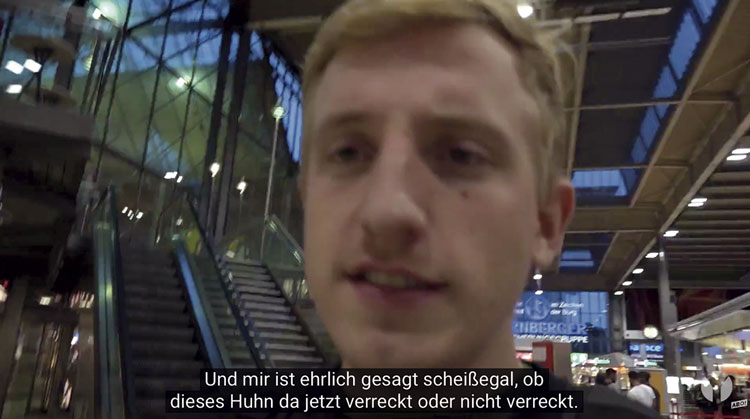
Screenshot. The captions read: »Honestly, I don‘t give a shit whether that chicken dies or not.«
The experiment was repeated in October 2024 with 167 young media users, who were likewise university students, using two additional reportages. Whereas the traditional ARTE reportage Mediterranean – Volunteering with SOS Méditerranée does not contain explicit subjective perspectives on the part of the reporters, the Y-Kollektiv reportage Sea rescue in the Mediterranean – When will the dying finally stop? includes explicit subjective references. Reporter Dennis Leiffels repeatedly expresses his personal perspective in an emotional and opinionated manner (see Figure 3):
Dennis Leiffels [13:38]: »What fates. And the situation is not improving. Now, during the summer, more and more people are setting out on this journey. What follows is an asylum procedure that will probably be discontinued sooner or later. I need to let off steam while we’re heading back to Lampedusa. Man, I’m angry and frustrated. How many more people have to die before we, the self-proclaimed guardians of human rights, finally start discussing a solution? I don’t know what that solution looks like either. But allowing thousands of people to die certainly cannot be one.«
Figure 3
»Sea rescue in the Mediterranean – when will the dying finally stop?« (Y-Kollektiv) Reporter Dennis Leiffels expresses his own opinion directly on camera.
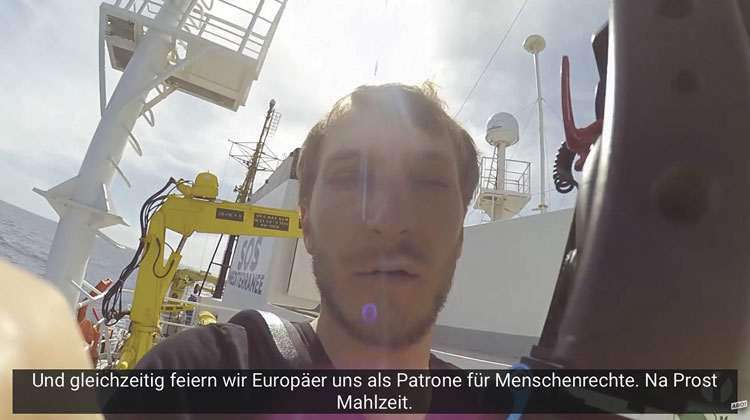
Screenshot. The captions read: »And at the same time, we Europeans like to see ourselves as the guardians of human rights. What a joke.«
In a second step, all participants completed an online questionnaire (see Figure 4). In addition to quantitative variables, the survey also included open-ended questions that allowed respondents to provide qualitative answers. The questionnaire was adapted from Meier’s (2018b) study but revised for forms of subjective journalism. In addition, in-depth semi-structured interviews were conducted with 35 selected participants to gain qualitative insights into the perception and effects of the reportages. Furthermore, 17 respondents participated in two focus group discussions moderated by the researcher.
For the analysis, six hypotheses regarding the potential intended effects of subjective journalism were developed on the basis of the literature and previously conducted semi-structured interviews with journalists working in subjective journalistic formats (see Brinkmann, 2025a, pp. 305–311). A seventh hypothesis was derived from media-journalistic criticism of subjective forms of journalism such as presenter reportages (see Reisin, 2022; Schwarzer, 2021; Kissler, 2021). The hypotheses formulate assumptions about the effects of explicitly subjective reportages in comparison with traditional reportages:
Information and interest
- H1: Users feel better informed/entertained/oriented after watching the content. (V1–2)
- H2: The content generates greater interest in the topic presented. (V3)
- H3: Users would like to watch more content by the author and/or medium in the future. (V4)
- H4: Users are able to recognize a subjectively mediated approach. (V5)
Engagement and willingness to act
- H5: Users would like to talk about the content with friends or relatives and/or share it. (V6–8)
Mental state
- H6: Users’ mental state is negatively affected. (V9)
Personal opinion
- H7: Users gain the impression that the content expresses a clear stance or opinion on the topic.
4. Presentation and discussion of the empirical findings
The seven hypotheses were tested using the ten quantitative variables from the standardized survey (see Tables 1–5), with arithmetic mean scores being reported (see Meier, 2018b, p. 12). The findings were additionally supplemented with qualitative data from the semi-structured interviews and focus group discussions in order to gain deeper insights into perceptions and effects.
The results show that the effects of subjective journalism need to be considered in a differentiated manner and cannot be described as unequivocally as existing findings on the programs, practices, and performance potentials of this journalistic concept might suggest. Although differences can be observed in the mean values of all hypotheses between the groups that viewed explicitly subjective content and those that viewed traditional content, thus justifying the formulation of directional hypotheses, these differences are generally less pronounced than originally expected.
Regarding the first three (sub-)hypotheses – whether users feel better informed, better oriented, and better entertained by subjective contributions – it is noticeable that the differences in the mean values are rather small (see Table 1). Only in the first set of reportages on factory farming do users feel noticeably better informed by the traditional contribution than by the explicitly subjective one (»very subjective, partly somewhat unreflective, but nevertheless consistently informative«; N173). In the second reportage on sea rescue, this effect is only weakly apparent, yet it is explicitly addressed by users in the qualitative survey:
»The contribution feels very contrived. There is a strong moral undertone throughout. I would have liked more factual information. There is no doubt that this is an emotional topic, but I feel emotionally manipulated rather than informed.« (N81)
»Very emotional, hardly factual.« (N133)
Although Y-Kollektiv is categorized by funk as an informational offering, users themselves do not appear to perceive this objective. Instead, they tend to feel that information is lacking in both subjective Y-Kollektiv reportages (»Too emotional and too little information«; N255; »The images were shocking, but I would have liked more figures and information«; N113) compared with the traditional contributions by Spiegel TV and ARTE.
Whereas respondents in the first experiment felt better oriented by the traditional reportage, this effect is reversed in the second experiment. Surprisingly, users perceive both subjective reportages as either equally or only marginally more entertaining than the traditional contributions (»While trying to absorb information, there are scenes that are apparently intended to entertain«; N12), even though the literature describes an entertaining approach as one of the advantages of subjective reporting.
The second hypothesis – namely that a subjective contribution generates greater interest in the topic presented – likewise cannot be confirmed on the basis of either survey (see Table 2). The differences are very small and vary depending on the topic of the reportage. For some respondents, however, the style of the subjective contribution on sea rescue did stimulate interest:
»I was able to relate well to the journalist’s emotions, which made the contribution more interesting and emotional for me. I listened attentively and learned a lot about the difficult situation.« (N25)
The third hypothesis must even be rejected. In both surveys, the young users indicated that they liked the subjective version of the reportage less and would not like to see this type of contribution more often:
Table 1
Results »information«, »orientation« and »entertainment«
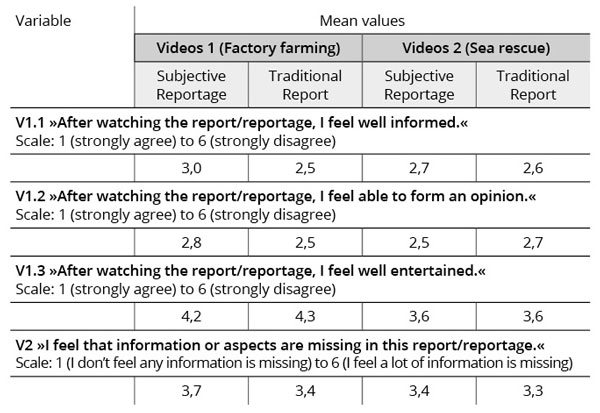
Mean Values (V1.1 – 1.3, V2; H1, n = 121-167 per group)
»Because of the choice of words and the almost accusatory style of the reportage, I can say that I prefer a more factual report such as the one from ARTE.« (N131)
»The reportage approaches the topic in a very one-sided way, which is not necessarily bad, but I prefer the way the Spiegel TV report tells the story.« (N45)
»Far too subjective! The presentation of the issue is good, but the typical Y-Kollektiv style makes it feel completely exaggerated and staged.« (N200)
In both subjective reportages, user criticism focused particularly on the role of the reporter.
»I felt that the contribution was too personal. The reporter took up too much space without adding any value. If the reporter occupies that much space, they should act more reflectively and not be so lacking in empathy and at times passively aggressive.« (N19)
»I found some of the reporter’s ironic comments very inappropriate, which occasionally made me angry. This is probably intended to polarize and stimulate discussion, encouraging people to exchange views about it. But to me, it comes across as inappropriate.« (N75)
»The contribution comes across as the deliberate self-presentation of a young journalist with a strong opinion that he was determined to communicate. […] In the end, it feels as though he has a great deal to say as an activist but offers no solutions. He unnecessarily mixes himself, his opinions, and his personal life into the story.« (N199)
Table 2
Results »interest«
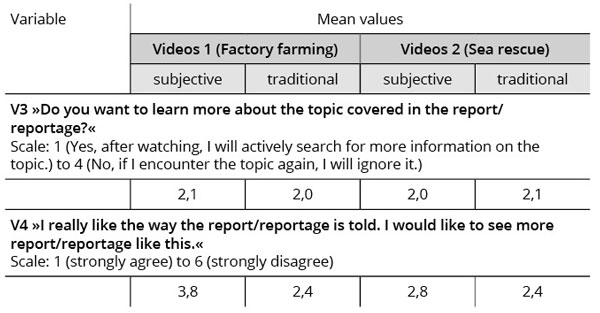
Mean values (V3-V4; H2-H3, n= 121-167 per group)
The results are initially clearer for the fourth hypothesis, which assumed that users would recognize a subjectively mediated approach. Respondents were therefore presented with a semantic differential (see Table 3). In both cases, the subjective reportages were perceived as more narrative, although this distinction was more pronounced for the first topic, factory farming. For the second topic, the differences between subjective and traditional reporting were only weakly perceived overall. While respondents rated the subjective reportage on factory farming as equally emotional and diverse as its traditional counterpart, they failed to recognize several other core characteristics of subjective journalism.
Table 3
Results »subjectivity/objectivity«
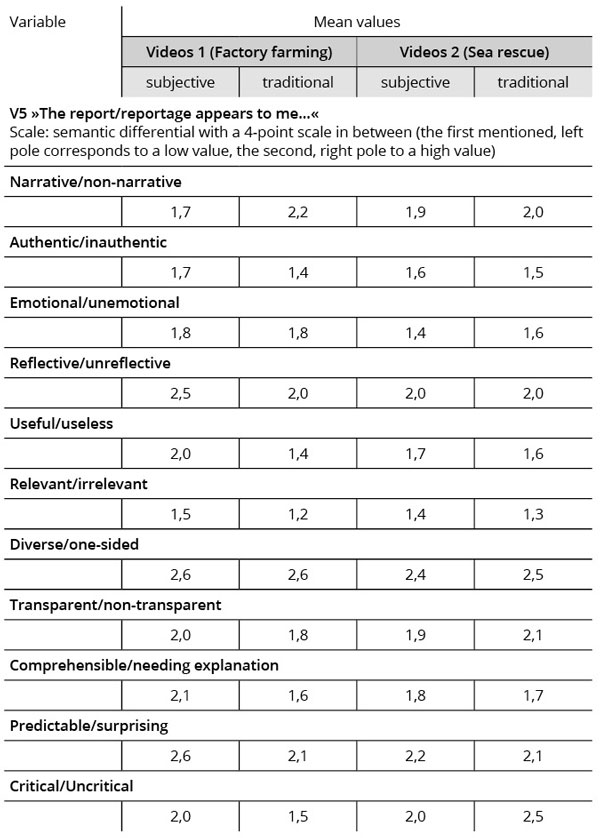
Mean values: (V5 H4, n = 121-167 per group)
The Y-Kollektiv reportage on factory farming was instead perceived as less authentic, less reflective, less relevant, and more in need of explanation:
»It is more of a personal experience report supplemented by additional information. The piece feels very ›raw‹. (…) Compared to the Spiegel video, it is much less factual and far more subjective.« (N9)
»The report seems confusing because, on the one hand, the reporter takes a clear position and, in the next moment, appears to hold a different opinion again.« (N245)
However, respondents perceived the subjective reportage as more surprising. There was also a clear perception that, for the first topic, the traditional reportage was more critical than the explicitly subjective version:
»The piece seems uncritical and biased to me. Reporter and protagonist are the same person, openly expressing their personal opinion throughout the reportage.« (N119)
For the second topic, refugee sea rescue, this perception was reversed. Here, respondents rated the Y-Kollektiv reportage as more critical:
»It [the report] appears more critical. It portrays more dramatically how refugees have to suffer violence, persecution, and slavery.« (N36)
»The issue was addressed more critically and from multiple perspectives here. The subjectivity creates a new, more personal layer, making the piece seem more comprehensible and vivid.« (N112)
But do users feel a stronger need to discuss the contribution with friends or relatives or to share it on social media, as the fifth hypothesis assumes? Here, the two experiments produced contrasting results (see Table 4).
Table 4
Results »engagement and empowerment«
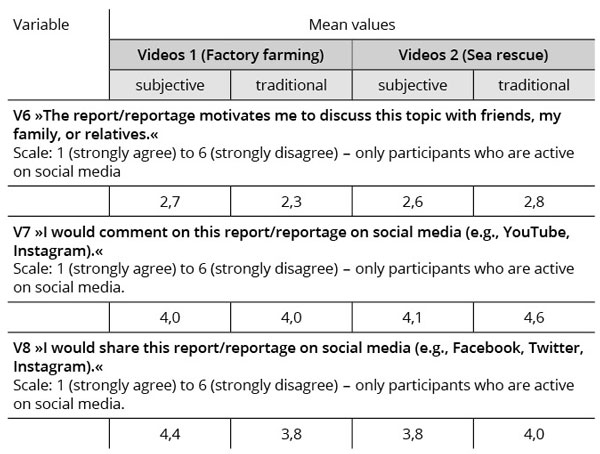
Mean values: (V6-V8; H5, n= 121-167 per group)
For the topic of factory farming, respondents were actually more likely to discuss the traditional contribution – and less likely to discuss the subjective one – with friends and family or share it on social media. In this case, the differences between the mean values were particularly pronounced.
By contrast, the subjective reportage on refugees elicited greater engagement and willingness to act: »I feel addressed personally, motivated to learn more about the issue, reflective, frustrated, and compelled to reconsider my own views.« (N167) Respondents indicated that they would not only discuss this piece more frequently with friends and relatives and share it more often, but would also be significantly more likely to comment on it on social media.
Table 5
Results »mental state«

Mean values (V9; H6, n= 121-167 per group)
The sixth hypothesis assumed that users’ emotional state would be affected more negatively by consuming the subjective reportage, since it could potentially be perceived as more emotional, authentic, critical, and overall more personal. Overall, the patterns are fairly similar in both experiments, with three notable exceptions (see Table 5). In the first experiment, users reported feeling more interested after watching the traditional reportage (in the second set of reportages, however, the difference between the two formats was negligible). The subjective reportage on factory farming was described by several respondents as »disgusting« (N12; N172): »Very uncensored, honest, and revolting. I actually felt sick while watching it. Some scenes genuinely shocked me.« (N201) The second set of reportages, meanwhile, left users feeling more depressed. Several respondents described the explicitly subjective contribution as »oppressive« (N12; N45; N165), »depressing,« or »sad« (N32; N109; N256). In both cases, however, users reported being more emotionally affected by the subjective reportages:
»The report was very powerful. Some of the conditions shown were disturbing at times, but unfortunately also highly realistic. Through the reporter, you had the feeling of being even closer to what was happening, especially because you could follow his personal journey in relation to the topic.« (N66)
»It made me want to learn more about the issue, and it affected me emotionally.« (N144)
»This contribution enables a high degree of empathy. You feel sorry for the people in need. You wish you could do something to help, but you do not know how. It is highly emotional and shapes a clear opinion for me – namely, that people in need must be helped.« (N207)
Do users gain the impression that a report contains a clear stance or opinion (e.g., on the part of the reporter)? Although the mean values for the seventh hypothesis differ considerably, the findings are once again contradictory: While, in the case of factory farming, users were significantly more likely to perceive opinions and attitudes in the traditional reportage, this pattern was reversed for the topic of refugees. Here, users were noticeably more likely to feel that the subjective reportage contained opinions and value judgments:
»The report conveys a very clear and unequivocal opinion, which is also reflected in the way it was filmed and narrated.« (N15)
»The report seemed much more sentimental […] and the creator of the video already appeared to hold a preconceived opinion, as he consistently sided with the refugees.« (N95)
»The report and the reporter take a clear position. It is obvious that he wants to support and ›prove‹ this position through his footage. He wants to convey a message.« (N202)
»The report comes across as highly opinionated. […] Through his positions, the reporter assumes the role of an advocate for the victims.« (N255)
»The report serves only entertainment and opinion formation, not the objective information of the audience. It promotes a clear stance, but one that is not substantiated by facts. It is a one-sided, subjective, and unreflective report.« (N186)
Table 6
Results »opinion«

Mean values (V10; H7, n= 121-167 per group)
5. Conclusion and outlook: How subjective journalism can have effects at the micro-, meso-, and macro-Level
Forms of subjective journalism aim to open up individual and personal perspectives on social problems and everyday-life phenomena (see Steensen, 2011) by making reporters’ expectations, experiences, and emotions an integral part of the journalistic story. For media users, the established journalistic W-questions can thus be expanded to include the question: »What does this do to me?« – a question that presenters in these reportages regularly and explicitly pose as the starting point for subjective reporting (see Brinkmann, 2025a, p. 381). An authentic, emotion-oriented audience strategy appears potentially well suited to conveying complex issues in an emotional, entertaining, and opinionated way and, particularly for young audiences, to providing important informational and orientational functions. This is precisely the claim made by the presenter formats of the public-service content network funk:
»Informative and orientation-oriented formats form a decisive part of funk’s public-service remit: To participate in political processes, take part in societal discourses, and make informed decisions, it is essential to understand what is happening in the world. Many offerings from the categories of information and orientation serve this need.« (funk, 2024)
Despite the risk of a self-referential »selfie journalism« (Brinkmann, 2024b), a narrative-emotional mode of address by (para-)journalistic actors such as presenters, hosts, or »newsfluencers« (see Bause, 2021; Henn, 2023; Duckwitz, 2023; Meier et al., 2025, pp. 45–46), combined with content optimized for social media platforms such as YouTube, Instagram, or TikTok, also appears to be a journalistically appropriate strategy for gaining reach and audience resonance among younger target groups. The extent to which these aims and potentials of subjective journalism can actually be realized was examined by exploring how young users perceive explicitly subjective reportage formats and how these formats affect them. The concept of subjective journalism pursues objectives at three levels.[4] It might be assumed that viewing a single piece of content is already sufficient to produce measurable effects on users (see Meier, 2018b, p. 19). However, the findings of this study show that the perception and effects of subjective journalism – at least in the case of explicitly subjective reportage formats – must be considered in a differentiated manner and that conclusions should therefore be drawn with caution:
- At the micro-level, users recognize key elements of subjective journalism, such as emotionality, narrativity, and opinion. However, they do not feel better informed or better oriented and, somewhat surprisingly, do not find themselves better entertained either. Nor do they clearly perceive explicitly subjective reportages as more authentic, more reflective, or more critical than traditional reportages.
- At the meso-level, it is noteworthy that users indicate they would be more likely to comment on subjective contributions on social media platforms, underscoring the discursive and participatory potential of this journalistic concept – a strategically important finding for media organizations with regard to younger target groups. Beyond this, however, no further effects could be measured: users do not express a desire to watch more subjective reportages, nor are they more likely to share them on social media. Likewise, interest in the topic, the medium, or the reporter is not demonstrably strengthened. Nevertheless, the large communities surrounding subjective presenter formats (e.g., STRG_F or Die Frage) suggest that this first-person approach to journalism can indeed foster a close relationship with audiences.
- At the macro-level, although users reported that subjective reporting affected them more emotionally and was more likely to stimulate discussion, the quantitative survey revealed few clear effects in terms of greater personal involvement and empowerment. However, the qualitative findings suggest that subjective reporting may increase problem awareness among some users, although it remains unclear whether this ultimately translates into greater civic engagement.
The findings of this study on perception and effects show that users recognize key characteristics of subjective journalism – such as emotion, narration, and opinion – in explicitly subjective formats. If »the schemes of journalism – such as reporting patterns and forms of presentation – are negotiated over the long term between producers and audiences within a media system« (Meier, 2018b, p. 20), and if journalistic practices and their modalities (e.g., topic and news factors, audience expectations, or media-ethical norms) are (re)produced through the recursive interplay of structural and performative elements (see Wyss, 2016; Buschow, 2018), the question arises as to whether this also applies to subjective journalism. Do users recognize whether a contribution primarily has a news-oriented and objective intention (the provision of information), pursues an investigative or interpretive approach (criticism or orientation), or seeks to open up a narrative-subjective perspective on a topic (personal engagement)? This study provides initial evidence that users are indeed able to distinguish between such reporting patterns; however, the findings are by no means as clear-cut as originally expected.
Moreover, the results may be subject to several sources of bias. First, the student participants surveyed possess specific media usage patterns and media literacy, meaning that the findings would likely differ among other groups of respondents. Second, reportage formats – which are inherently subjective forms of presentation (see Brinkmann, 2024a, pp. 86–88) – were selected for both experiments. As a result, compared with traditional reportages, the explicit characteristics of subjective presenter formats may not have been sufficiently pronounced. It therefore seems worthwhile to compare subjective forms of journalism, from the perspective adopted in this study, with other, more »objective« forms of presentation (e.g., background reports or feature articles) in order to identify potentially stronger effects.
About the author
Janis Brinkmann, Dr. phil. habil. (1987), has been Professor of Digital and Interactive Media at the Institute of Communication Management at Osnabrück University of Applied Sciences since 2026. Prior to this, he was Professor of Journalism in the Digital Information Economy at the Faculty of Media at Mittweida University of Applied Sciences from 2017 to 2026. His research focuses on digital journalism, interactive storytelling formats, subjectivity in journalism, and questions of journalistic quality and ethics. Contact: j.brinkmann@hs-osnabrueck.de
References
Bause, Halina (2021). Politische Social-Media-Influencer als Meinungsführer? Publizistik, 66, 295–318.
Behre, Julia, Hölig, Sascha, Stöwing, Ezra, & Möller, Judith (2025). Reuters Institute Digital News Report 2025 – Ergebnisse für Deutschland. Verlag Hans-Bredow-Institut.
Bleicher, Joan Kristin, & Pörksen, Bernhard (eds.). (2004). Grenzgänger: Formen des New Journalism. Springer VS.
Brinkmann, Janis (2023). Journalistische Grenzgänger. Wie die Reportage-Formate von funk Wirklichkeit konstruieren. Arbeitsheft 111 der Otto-Brenner-Stiftung. https://www.otto-brenner-stiftung.de/journalistische-grenzgaenger/ (26.09.2025)
Brinkmann, Janis (2024a). Journalismus – Eine praktische Einführung (2nd ed.). Nomos.
Brinkmann, Janis (2024b). Reporterinnen oder Journalisten-Darsteller? Selfie-Journalismus als kommunikative Praxis in der Figuration des subjektiven Journalismus. In Uwe Eisenbeis, Melanie Mezger & Lars Rinsdorf (eds.), Kreativwirtschaft und Creator Economy. Proceedings zur Jahrestagung der Fachgruppe Medienökonomie der DGPuK 2023 in Stuttgart (pp. 130-144). Deutsche Gesellschaft für Publizistik- und Kommunikationswissenschaft.
Brinkmann, Janis (2025a). Subjektiver Journalismus. Theorie, Konzept, Praxis. Springer VS.
Brinkmann, Janis (2025b). Authentisch, emotional, partizipativ: Neue Qualitätskriterien eines neuen Journalismus. In Vanessa Kokoschka, Stefan Kosak, Claudia Paganini, & Rademacher, Lars (eds.), Nachhaltigkeit in der Medienkommunikation. Ethische Anforderungen und praktische Lösungsansätze (pp. 133–152). Nomos.
Brinkmann, Janis, Amrhein, Christof, & Pröhle, Anna (2025). Ich-Erzähler*innen. Neue Reportage-Formate im öffentlich-rechtlichen Rundfunk. Arbeitsheft 80 der Otto-Brenner-Stiftung. https://www.otto-brenner-stiftung.de/ich-erzaehler-innen/ (26 September 2025)
Buschow, Christopher (2018). Die Neuordnung des Journalismus. Eine Studie zur Gründung neuer Medienorganisationen. Springer Fachmedien.
Chong, Phillipa (2019). »Valuing Subjectivity in Journalism: Bias, Emotions, and Self-Interest as Tools in Arts Reporting.« Journalism, 20(3), 427–443.
Dennis, James, & Sampaio-Dias, Susana (2021). »Tell the Story as You’d Tell It to Your Friends in a Pub«: Emotional Storytelling in Election Reporting by BuzzFeed News and Vice News. Journalism, 22(12), 1608–1628.
Drössler, Kira (2021). Formate für Digital Natives. Innovatives Entwickeln, Umsetzen und Managen. Strategien und Erfolgsfaktoren für junge Social Media Formate. Springer VS.
Duckwitz, Amelie (2023). Influencer*innen im digitalen Wahlkampf. In Martin Fuchs & Martin Motzkau (eds.), Digitale Wahlkämpfe. Politische Kommunikation im Bundestagswahlkampf 2021 (pp. 57-84). Springer Fachmedien.
Evers, Tanja, Greck, Regina, & Altmeppen, Klaus-Dieter (2021). Die Strickmuster auseinanderhalten: Strickmuster des politischen Journalismus. In Marlis Prinzing & Roger Blum (eds.), Handbuch Politischer Journalismus (pp. 439–462). Herbert von Halem.
Fink, Christin (2016). Journalistische Genres. Idealismus, Realität und neue Normen. In DFJV (eds.), Journalistische Genres (pp. 9-18). Herbert von Halem.
funk (2024). Funk-Bericht 2024. https://presse.funk.net/pressemeldung/funk-bericht-2024/ (26 September 2025)
funk (2023a). Y-Kollektiv. Formatinfos. Funk Presse. https://presse.funk.net/format/y-kollektiv/ (26 September 2025)
funk (2023b): Follow me.reports. Formatinfos. Funk Presse. https://presse.funk.net/format/follow-me/ (26 September 2025)
Goutier, Nele, de Haan, Yael, de Bruin, Kiki, Lechler, Sophie, & Kruikemeier, Sanne (2021). From »Cool Observer« to »Emotional Participant«: The Practice of Immersive Journalism. Journalism Studies, 22(12), 1648–1664.
Greber, Hannah, Lechler, Sophie, Aaldering, Loes, de Haan, Yael, Kruikemeier, Sanne, Goutier, Nele, & de Bruin, Kiki (2023a). Feeling the News? The Differential Effects of Immersive Journalism on Emotional Response. Digital Journalism, 11(1), 39–60.
Greber, Hannah, Aaldering, Loes, & Lechler, Sophie (2023b). The Worthwhileness of Immersive Journalism – Taking on an Audience Perspective. Journalism Practice, 19(1), 20–38.
Greck, Regina, & Kössler, Tanja (2013). Journalismus und Berichterstattung. In Klaus-Dieter Altmeppen & Klaus Arnold (eds.), Journalistik: Grundlagen eines organisationalen Handlungsfeldes (pp. 107–119). Oldenbourg.
Haas, Hannes (1999). Empirischer Journalismus. Verfahren zur Erkundung gesellschaftlicher Wirklichkeit. Böhlau.
Haller, Michael (2020). Die Reportage. Theorie und Praxis des Erzähljournalismus. Herbert von Halem.
Harbers, Frank (2016). Time to Engage. De Correspondent’s redefinition of journalistic quality. Digital Journalism, 4(4), 494–511.
Harbers, Frank, & Broersma, Marcel (2014). Between engagement and ironic ambiguity: Mediating subjectivity in narrative journalism. Journalism, 15(5), 639–654.
Henn, Halina (2023), Von Laien und Profis: Typen politischer Influencerkommunikation auf YouTube. Studies in Communication and Media, 2–3(12), 242–269.
Hohlfeld, Ralf (2003). Vom Informations- zum Pseudojournalismus. Berichterstattungsmuster im Wandel. Communicatio Socialis, 36(3), 223–243.
Keinert, Alexa, Heft, Annett, & Dogruel, Leyla (2019), »Wie sehen News-Entrepreneurs die Zukunft ihrer Profession? Vier Thesen zum Journalismus von morgen.« Journalistik, 2/3, 171–188.
Kissler, Alexander (2021, October 5). Linke Politik und Sex. Das Jugendangebot »Funk« von ARD und ZDF ist zum Chefankläger der Mehrheitsgesellschaft geworden. Neue Zürcher Zeitung, 28.
Lechler, Sophie (2020). The Emotional Turn in Journalism Needs to be About Audience Perceptions. Digital Journalism, 8(2), 287–291.
Lindgren, Mia (2017). »Autoethnographic Journalism: Subjectivity and Emotionality in Audio Storytelling.« In Nicholas Monk, Mia Lindgren, Sarah McDonald, & Sarah Pasfield-Neofitou (eds.), Reconstructing Identity (pp. 183–206). Palgrave Macmillan.
Loosen, Wiebke, Ahva, Laura, Reimer, Julius, Solbach, Paul, Deuze, Mark & Matzat, Lorenz (2020). ›X Journalism‹. Exploring journalism’s diverse meanings through the names we give it. Journalism, 23(1), 39–58.
Maras, Steven (2013). Objectivity in Journalism. Polity Press.
McNair, Brian (2017). After Objectivity? Schudson’s sociology of journalism in the era of post-factuality. Journalism Studies, 18(10), 1318–1333.
Meier, Klaus (2018a). Journalistik. UVK Verlagsgesellschaft.
Meier, Klaus (2018b). Wie wirkt Konstruktiver Journalismus? Ein neues Berichterstattungsmuster auf dem Prüfstand. Journalistik, 1, 4–25.
Meier, Klaus (2019). Berichterstattungsmuster als Strategien der Komplexitätsreduktion. In Beatrice Dernbach, Alexander Godulla, & Annika Sehl (eds.), Komplexität im Journalismus (S.101-116). Springer VS.
Meier, Klaus, Graßl, Michael, Klinghardt, Korbinian, Körner, Maike, & Schützeneder, Jonas (2025). Die Zukunft des Journalismus. Zehn Szenarien für das nächste Jahrzehnt. Springer VS.
Mellado, Claudia, & Gajardo, Constanza (2026). »The Importance of the Human Touch in Journalism: Journalistic Values from an Audience Perspective.« Journalism Practice, 20(3), 747–764.
Neuberger, Christoph, & Mayer, Anna-Theresa (2026). »Was ist subjektiver Journalismus? Bedeutung und Relevanz für die Erfüllung des öffentlich-rechtlichen Auftrags. Eine Analyse am Beispiel des ARD/ZDF-Content-Netzwerks funk.« Media Perspektiven, 3, 1–24.
Newman, Nic, Arguedas, Amy Ross, Robertson, Craig T., Nielsen, Rasmus Kleis, & Fletcher, Richard (2025): Reuters Institute Digital News Report 2025. https://reutersinstitute.politics.ox.ac.uk/sites/default/files/2025-06/Digital_News-Report_2025.pdf (26 September 2025)
Pajnik, Mojca (2023). Professionalizing Emotions as Reflective Engagement in Emerging Forms of Journalism. Journalism Studies, 25(2), 181–198.
Pauly, John J. (2014). The New Journalism and the struggle for interpretation. Journalism, 15(5), 589-604.
Raeijmaekers, Daniëlle, & Maeseele, Pieter (2017). In objectivity we trust? Pluralism, consensus, and ideology in journalism studies. Journalism, 18(6), 647–663.
Reineck, Dennis (2024). »Qualität des Journalismus.« In Martin Löffelholz & Liane Rothenberger (eds.), Handbuch Journalismustheorien (pp. 541-554). Springer VS.
Reinemann, Carsten & Baugut, Philipp (2016). Journalismus als subjektiv rationales Handeln im sozialen Kontext. In Martin Löffelholz & Liane Rothenberger (eds.), Handbuch Journalismustheorien (pp. 309–321). Springer VS.
Reisin, Andrej (2022). Reporterformate: Ein »authentischer« Host ersetzt keine Recherche. Übermedien vom 8. April 2022. https://uebermedien.de/69778/ein-authentischer-host-ersetzt-keine-recherche/ (26.09.2025)
Reus, Gunter (2019). Ja, Fiktionalität passt in den Journalismus. Entscheidend ist Transparenz. Journalistik, 1, 65-69.
Savinova, Elena, & Hoek, Jan (2025). »Is Social Media News More Subjective? A Comparative Study of British Quality and Popular News Sources’ Adaptation to Facebook.« Digital Journalism, 13(7), 1291–1310.
Schlütz, Daniela (2020). »Auditive ›deep dives‹. Podcasts als narrativer Journalismus.« kommunikation@gesellschaft, 21(2), 1–18.
Schudson, Michael (2001). The objectivity norm in American journalism. Journalism, 2(2), 149–170.
Schultz, Tanjev (2019). Nein, Fiktionalität passt nicht in den Journalismus. Über den Unterschied von fiktionalem und faktualem Erzählen. Journalistik, 1, 70–77.
Schultz, Tanjev (2021). Der Reporterblick von nirgendwo? Journalismus in der Spannung zwischen Objektivität und Subjektivität. Publizistik, 66, 21–41.
Schwarzer, Matthias (2021). Reportageformate bei Funk: Das große Fest der Einzelschicksale. RND.de vom 5. August 2021. https://www.rnd.de/medien/funk-reportageformate-journalismus-oder-unterhaltung-das-grosse-fest-der-einzelschicksale-N4YZR7GZ7FGY7IP7YLZCFQ4YTA.html (26.09.2025)
Smeenk, Kim, Harbers, Frank, & Broersma, Marcel (2023). »The Journalist in the Story: Conceptualizing Ethos as Integral Framework to Study News Production, News Texts and News Audiences.« Communication Theory, 33(4), 214–222.
Smeenk, Kim, Harbers, Frank, & Broersma, Marcel (2024). »Highlighting and Downplaying Subjectivity through Ethos Construction: Personal Journalism as a Pluriform Epistemic Practice.« In Journalism, 26(3), 2523–2543.
Smeenk, Kim, Harbers, Frank, Kruitbosch, Hanne, & Broersma, Marcel (2025). »The Reporter as First-Person Witness: Eyewitnessing and Subjectivity in Epistemic Authority Claims in Personal Journalism.« Journalism Practice, 1–19.
Smeenk, Kim, Kruitbosch, Hanne, Harbers, Frank, & Broersma, Marcel (2026). »When Journalists Share Their Happy Feelings: Affective Connection as a Source of Reliability in Personal Journalism.« Journalism Studies, 27(3), 360–380.
Steensen, Steen (2011). The Featurization of Journalism. Nordicom Review, 32/2, 49–61.
Steensen, Steen (2017). Subjectivity as a Journalistic Ideal. In Bente Kalsnes Fonn, Henriette Hornmoen, Nathalie Hyde-Clarke, & Yngvar Bordewich Hågvar (eds.), Putting a Face on it: Individual Exposure and Subjectivity in Journalism (pp. 25–47). Cappelen Damm Akademisk.
Stringer, Paul (2018). Finding a Place in the Journalistic Field. The pursuit of recognition and legitimacy at BuzzFeed and Vice. Journalism Practice, 19(13), 1991–2000.
Tandoc, Edson C. (2017). Five ways BuzzFeed is preserving (or transforming) the journalistic field. Journalism, 19(2), 200–216.
Uth, Bernadette (2025). Hardly Used, But Highly Appreciated? Use, Importance and Effects of Engagement-Oriented Journalism. Digital Journalism, 1–23.
Wahl-Jorgensen, Karin (2020). An Emotional Turn in Journalism Studies? Digital Journalism, 8(2), 175–194.
Wahl-Jorgensen, Karin (2013). The strategic ritual of emotionality: A case study of Pulitzer Prize-winning articles. Journalism, 14(1), 129–145.
Wang, Haiya, & Ni, Yuyao (2025). Constructing Authenticity as an Alternative to Objectivity: A Study of Non-Fiction Journalism in Chinese Media. Journalism and Media, 6(1), 40–55.
Weischenberg, Siegfried (1995). Journalistik. Theorie und Praxis aktueller Medienkommunikation. Band 2. Medientechnik, Medienfunktionen, Medienakteure. Westdeutscher Verlag.
Wyss, Vincent (2016). Journalismus als duale Struktur. In Martin Löffelholz & Liane Rothenberger (eds.), Handbuch Journalismustheorien (pp. 265–280). Springer VS.
Wyss, Vinzenz, & Keel, Guido (2010). Journalismusforschung. In Heinz Bonfadelli, Otfried Jarren, & Gabriele Siegert (eds.), Einführung in die Publizistikwissenschaft (pp. 337–378). utb.
Appendix
Questions and variables in the standardised survey of young media users (based on Meier, 2018b)
Variables and questions:
V1.1 »After watching the report/reportage, I feel well informed.«
Scale: 1 (fully applies) to 6 (does not apply at all)
V1.2 »After watching the report/reportage, I feel well able to form an opinion.«
Scale: 1 (fully applies) to 6 (does not apply at all)
V1.3 »After watching the report/reportage, I feel well entertained.«
Scale: 1 (fully applies) to 6 (does not apply at all)
V2 »I feel that information or aspects are missing in this report/reportage.«
Scale: 1 (no information missing) to 6 (much information missing)
V3 »Do you want to learn more about the topic covered in the report/reportage?«
Scale: 1 (Yes, after watching I will actively research/seek the topic) to 4 (No, if I encounter the topic again, I will ignore it)
V4 »I really like the way the report is told. I would like to see more reports/reportages like this.«
Scale: 1 (fully applies) to 6 (does not apply at all)
V5 »The report/reportage appears to me…«
Scale: Semantic differential with 4-point scale in between (the first mentioned, left pole corresponds to a low value, the second, right pole to a high value)
…Narrative/non-narrative
…Authentic/inauthentic
…Emotional/unemotional
…Reflective/unreflective
…Useful/useless
…Relevant/irrelevant
…Diverse/one-sided
…Transparent/non-transparent
…Comprehensible/needing explanation
…Predictable/surprising
…Critical/uncritical
V6 »The report/reportage motivates me to discuss this topic with friends, my family, or relatives.«
Scale: 1 (fully applies) to 6 (does not apply at all)
V7 »I would comment on this report/reportage on social media (e.g., YouTube, Instagram etc.).«
Scale: 1 (fully applies) to 6 (does not apply at all) – only those active in social networks
V8 »I would share this report/reportage on social media (e.g., Facebook, Twitter, Instagram etc.).«
Scale: 1 (fully applies) to 6 (does not apply at all) – only those active in social networks
V9 »You have now watched the report/reportage. How did you feel after watching?«
Scale: Semantic differential with 4-point scale in between
…Bored/interested
…Unimpressed/impressed
…Depressed/not depressed
…Emotionally touched/factually informed
V10 »I feel that the report/reportage expresses a clear opinion.«
Scale: 1 (fully applies) to 6 (does not apply at all)
Footnotes
1 Thus, the model integrates various theoretical approaches: In addition to constructivist and systems theory-informed perspectives (e.g., on journalistic perception and reporting patterns), it combines practice and structuration theory with elements from the research field of journalistic quality (Brinkmann, 2025a, pp. 787–794).
2 This additional dimension of the model thus directly connects to the first dimension of journalistic programs for the construction of reality. However, it shifts the focus away from journalists, who construct social reality, towards users and their perceptions of this journalistically constructed reality from the perspective of media use and effects research, thereby making it possible to analyze specific effects.
3 »The Y-Kollektiv reporters show the world as they experience it – […] Real, close, human, and subjective. […] Our documentaries and reports provoke and polarize, they excite and shock; they are not always objective, but always honest« (funk, 2023a); »follow me.reports is an interactive reportage format for empathizing, where the stories, topics, and questions come directly from the community […] At follow me.reports, every story is told by journalists and hosts from the funk universe, […] giving each episode a unique and authentic perspective« (funk, 2023b).
4 Brinkmann (2025a, pp. 773–782) has shown, drawing on the structural-individualist approach developed by Reinemann and Baugut (2016), how the development of subjective journalism can be theoretically modelled and empirically described as a trend extending from the societal macro-level, via the meso-level of journalistic organizations, to the micro-level of subjectively rational journalists and back to the macro-level.
About this article
Copyright
This article is distributed under Creative Commons Atrribution 4.0 International (CC BY 4.0). You are free to share and redistribute the material in any medium or format. The licensor cannot revoke these freedoms as long as you follow the license terms. You must however give appropriate credit, provide a link to the license, and indicate if changes were made. You may do so in any reasonable manner, but not in any way that suggests the licensor endorses you or your use. You may not apply legal terms or technological measures that legally restrict others from doing anything the license permits. More Information under https://creativecommons.org/licenses/by/4.0/deed.en.
Citation
Janis Brinkmann: How does subjective journalism work?. Perceptions and effects of an alternative form of journalism among young media users. In: Journalism Research, Vol. 9 (2), 2026, pp. 109-136. DOI: 10.1453/2569-152X-22026-16218-en
ISSN
2569-152X
DOI
https://doi.org/10.1453/2569-152X-22026-16218-en
First published online
August 2026