

By Alf Mayer and Horst Pöttker
Abstract: This article documents the largely overlooked role of publisher and resistance fighter Karl Anders in the history of the German national newspaper Frankfurter Rundschau, drawing on extensive archival sources, court records, and contemporary documents. In the mid-1950s, Anders played a decisive role in stabilizing the financially threatened newspaper through loans, publishing expertise, and journalistic networks. Nevertheless, following his falling out with the newspaper’s publisher Karl Gerold, his contribution was systematically erased from the newspaper’s institutional memory. The essay analyzes this form of journalistic »gap in public discourse« as an example of mechanisms of repression, concealment, and myth-making in media journalism. In doing so, it discusses the professional ethical question of to what extent the omission of relevant information should be considered a violation of journalistic duties of care.
Ironically, the publisher Karl Anders – without whom the Frankfurter Rundschau (FR) would not have survived its first ten years – is »terra incognita« at this newspaper. Since 1957, he has been erased from the newspaper’s in-house historiography and collective memory – as if he had fallen victim to »damnatio memoriae.« This omission benefited – and continues to benefit – publisher Karl Gerold.
How does forgetting or repression work at a newspaper? At a left-leaning, enlightened, and critical one, no less?[1] How can entire generations of FR journalists be ignorant of their own newspaper’s history? This article explores these questions.
1. Who was Karl Anders?
Karl N. Anders, as his name was printed in bold and featured prominently in the Rundschau masthead from 1954 to 1957, was actually once named Kurt Wilhelm Naumann. He hailed from Köpenick in Berlin and went underground as the agitprop director of the Communist Party of Germany (KPD) on the day Adolf Hitler was appointed Chancellor of the Reich, organizing illegal printing presses and the distribution of leaflets. He lived through the »Köpenick Blood Week« in June 1933, changed his identity »more often than my shirts,« and literally became a different person. He was forced to leave Germany, ended up in England via Slovakia and Poland, and subsequently joined Waldemar von Knoeringen and other émigrés in the socialist resistance group »Neu beginnen! [Beginning anew!]« He produced broadcast programs for workers for the British-funded enemy station »Europäische Revolution [European Revolution]« until it was shut down in 1943, then worked for the BBC’s German service, making many connections[2], for example with Eric Ambler, Victor Gollancz, the brothers Hugh and Graham Greene, and, of course, many emigrants. Shortly after the surrender of the Nazi regime, he traveled through Germany with Hugh Greene and Alan Bullock, becoming one of the first exiles to return. For the BBC’s German service, he reported for a year on the Nuremberg trials of the major war criminals. He was housed alongside Hemingway, Martha Gellhorn, John Steinbeck, Erich Kästner, John Dos Passos, Ilya Ehrenburg, and Robert Jungk at the Faber-Castell family’s »Pencil Castle« in Fürth. Andreas Pflüger’s novel Ritchie Girl (Pflüger, 2021) contains a small homage. Unlike FR publisher Karl Gerold, whose history of resistance has remained astonishingly undocumented, Karl Anders – as an editor for the enemy broadcaster »European Revolution« and later the BBC – had indeed »verifiably and to a great extent publicly incited hatred against Germany abroad,« according to the standard justification for expatriation used against regime opponents at the time. According to his daughter, he only regained German citizenship with great difficulty in 1958[3].
For Anders, who had always been an avid reader, it was clear that a new Germany needed new books – and democratic literature. For him, an essential part of that were crime novels! He was the first to publish Raymond Chandler, Dashiell Hammett, and Eric Ambler in German. He did so through the Nest-Verlag, the publishing house he founded together with Rudolf Zitzmann and Willi Geusendam, both of whom had been persecuted by the Nazis. The publishing house was modeled after Victor Gollancz, his British publisher friend from exile, and also published Gollancz’s books. It offered a remarkable political and re-educational program dedicated to international understanding, active coming to terms with the past, and a new socialist politics. A particularly important book of this period is Paul Sering’s (i.e., Richard Löwenthal) Jenseits des Kapitalismus [Beyond Capitalism], which was also published by the Nest-Verlag.[4]
The seventh book published by Nest-Verlag in 1948 was a work whose political analysis remains timeless to this day: Im Nürnberger Irrgarten [In the Nuremberg Maze]. In it, Karl Anders focused his reporting on the war crimes trials of twelve prominent Nazis, attempting to explore the inner workings and mechanisms of the Nazi system in a nuanced manner. He took the relevant chapters into the prison cells of Speer, Papen, Schacht, and Goebbels’ deputy Fritzsche, incorporating these conversations about guilt and conscience into the text. The politically astute journalist also noted the problem of »collective guilt« (which he rejected, as did his British publisher friend Victor Gollancz) as early as in the courtroom: »If one cannot come to terms with guilt, one builds Germany’s future on a foundation of lies, of complacency, on a moral morass, and that is worse than building it on sand. […] Will it become a new guilt of the German people, having learned nothing from their own past?« (Anders, 1948, p. 221f.)
Karl Anders enjoyed the trust of key comrades of the Social Democratic Party (SPD) – in part stemming from his time in the Resistance and in exile – such as Alfred Nau, Willy Brandt, and Fritz Heine. The latter was a lifelong friend, closely intertwined with »der Konz,« the »Konzentration GmbH,« the holding company for the SPD’s press organizations. Even after leaving the Frankfurter Rundschau, Karl Anders continued to work for its business consulting department as a consultant and publishing turnaround specialist, and the FR also benefited from the expertise gathered there from 1954 to 1957. Karl Anders was regarded as an expert in publishing turnarounds; he possessed not only extensive journalistic experience but also considerable business acumen. In light of his history as a member of the Resistance and his achievements in publishing, he received numerous public honors, including the Cross of Merit, First Class, of the Federal Republic of Germany in 1977. He had joined the SPD in 1949 and was part of a network of émigré Social Democrats. In 1961, he was appointed to the SPD’s central campaign committee; he organized Willy Brandt’s first campaign for chancellor and served as a member of the SPD’s Commission on Fundamental Values. Anyone who recalls the accusations leveled against »Herbert Frahm« and the »stateless fellow« Willy Brandt can imagine the minefield that the returnee Anders likely navigated within the FR in the mid-1950s.
2. Karl Anders saves the Frankfurter Rundschau
Former BBC journalist Karl Anders was brought to the FR by Karl Gerold in 1954. Gerold even transferred his own publishing shares to him, making him a co-publisher. Anders came with a long-term bank loan of 2 million DM, which was directly linked to him as guarantor and trustee. This saved the newspaper, which was on the brink of financial ruin. The loan came from the Bank für Gemeinwirtschaft (BfG), the bank of the SPD, and the trade unions. The lenders expressly noted that the purpose and goal was to secure the independence of the Frankfurter Rundschau (see Mayer, 2025d).
With the loan, Anders restructured the FR’s printing operations, turning them into a profitable venture. He used it to acquire »Heidelberger« printing presses, entered the lucrative four-color printing business, and signed a contract with Josef Neckermann to print mail-order catalogs, which in 1960 made possible the construction of the Neu-Isenburg printing center – at times the largest and most modern newspaper printing plant in Europe. In this way, he laid the foundation for the publishing house’s highly successful printing division, which ensured the paper’s journalistic freedom for decades. All of this meant editorial freedom and precisely that independence of which the Rundschau had always been proud – and which is associated with the person of Karl Anders.
At the same time, his long-standing and authentic connections to the literary exile scene established the good reputation of the arts section and the newspaper at large. Immediately after the end of the war, he had published authors such as Oskar Maria Graf and, as vice-chairman of the Association of Socialist Publishers, Booksellers, and Librarians, enjoyed high esteem among the critical minds and authors of the postwar era. In addition, he had maintained a keen eye on the Anglo-Saxon non-fiction world. The 1960 Peace Prize of the German Book Trade, awarded to the promoter of international understanding Victor Gollancz, was also to his credit: thus, the FR’s publishing house gained a Peace Prize laureate for its catalog.
Karl Anders summarized his joining the FR in a note to his lawyer as follows:
»Friendship with Gerold since 1949. Never had any illusions about the fact that G. was a drinker and irresponsible in many ways, but I am friends with several other ›difficult‹ people.
In 1954, after Rudert’s death, G. sought my advice on several occasions and offered me the position of managing director and publishing director. I declined. ›Never as an employee of Gerold.‹
The situation at the ›Rundschau‹ became increasingly complicated. G. was practically incapable of conducting business. The bank loan was terminated as of September 1. I negotiated with Dahrendorf. He said: ›Not a penny for G.‹ After three refusals, I was prepared to join the Rundschau.
1) As the bank’s representative (two million credit line)
2) Partner
3) Managing director with a lifetime contract.
On July 17, 1954, I joined with provisional powers. G. was on extended leave. As of September 1, 1954, I became the official managing director. For more than two years, G. left the business and technical management of the company entirely to me. He traveled a great deal and was quite happy that he did not have to concern himself with matters that held little interest for him. In the spring of 1956, G. underwent a detoxification treatment.«
In Gerold’s absence, Karl Anders signed the 1954 annual report. Gerold himself noted for 1954: »Mr. Anders was appointed on July 15 as an advisor and authorized representative of Mr. Gerold, and on September 3 was appointed by the shareholders as an equal managing director.« (Mayer, 2025c and d). At that time, the masthead still noted the absence of those responsible under press law on a daily basis, presumably a remnant from the licensing years of the occupation. It was striking how often the suffix »(abw.) [absent]« appeared after Karl Gerold’s name. According to the masthead, the sole person primarily responsible for the newspaper on such days was then Karl N. Anders, »Managing Director and Publisher.«
Figure 1
Loan from BfG, tied to Karl Anders as guarantor
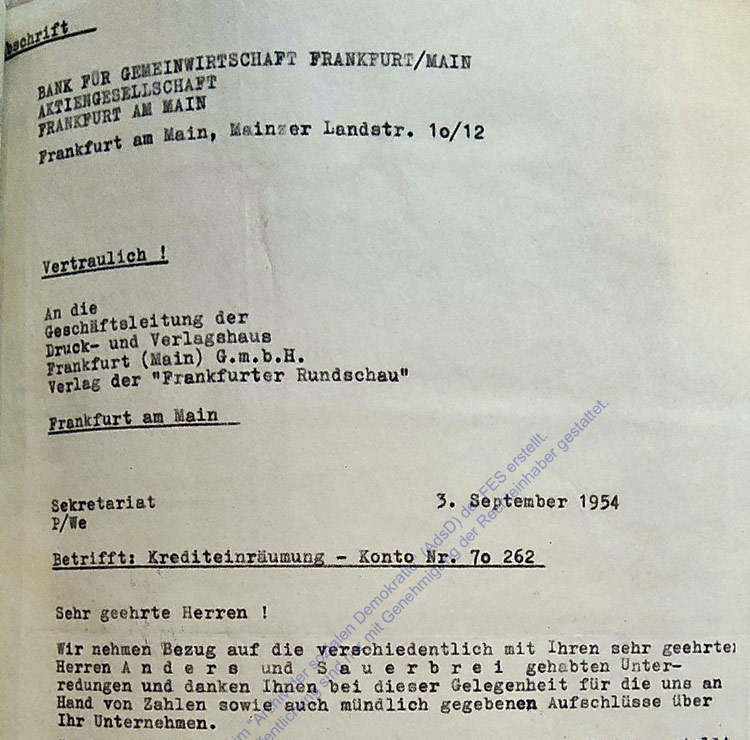
Source: Karl Anders Papers, Archive of Social Democracy, Friedrich Ebert Foundation (Archiv der sozialen Demokratie, Friedrich-Ebert-Stiftung).
Figure 2
Reason for the loan: explicitly granted to preserve the newspaper’s independence
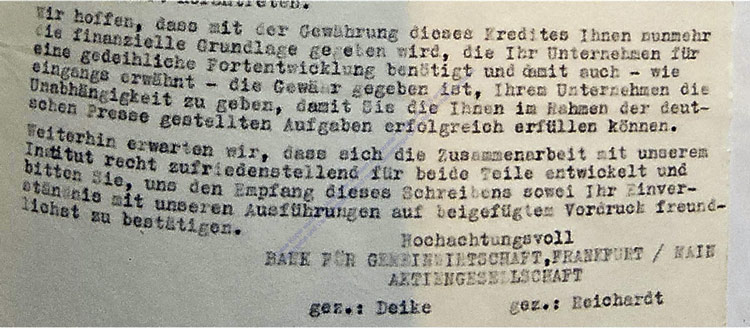
Source: Karl Anders Papers, Archive of Social Democracy, Friedrich Ebert Foundation (Archiv der sozialen Demokratie, Friedrich-Ebert-Stiftung)
3. The Frankfurter Rundschau drops Karl Anders
The relationship between Gerold and Karl Anders then deteriorated rapidly. In early August 1957, when the newspaper had long been saved and operations were fully consolidated, Gerold emerged once again from a stint in rehab and, from one day to the next, forced his friend and co-publisher Karl Anders out of the business. This occurred without consulting the in-house lawyer and, in the ensuing trial – which went through two instances – with increasingly unrestrained arguments.
Karl Anders had sued Gerold over his dismissal. In the complaint filed by Henry Ormond and Anders, they reflected on Karl Anders’s entry into the company:
»Time was running out; the creditors were growing impatient. Something had to be done. Mr. Gerold had approached the plaintiff, with whom he had been friends for years, on several occasions to seek advice and assistance. He had also traveled to Nuremberg for this purpose to discuss a financial stake by the Nürnberger Nachrichten in the Frankfurter Rundschau with the plaintiff, who was acting there as the sole shareholder and managing director of Nest-Verlag, and with the publisher Dr. Drexel. The plaintiff had rejected Mr. Gerold’s offers to become managing director, as the idea of entering into a relationship of dependence on Mr. Gerold seemed impossible to him. He did, however, make efforts to secure the loan for Mr. Gerold.
The situation became increasingly difficult. Mr. Gerold was in no way up to the task. The continued existence of the defendant (i.e., the printing and publishing house in Frankfurt) and the Frankfurter Rundschau was at risk. The bank loan of 1.6 million DM had been terminated as of September 1, 1954. No one knew where to get the money. Finally, after having refused several times, the plaintiff decided, out of a sense of political responsibility and friendship toward Mr. Gerold, to accept the position of managing director and publishing director, since only under this condition could the necessary loan be secured and the company saved.«
When Gerold attacked Anders’s professional and personal qualifications, his lawyer Henry Ormond – the principal co-plaintiff in the Frankfurt Auschwitz trial and previously one of the founding fathers of leading national magazine Der Spiegel – organized a smear campaign that today would likely be likened to a social media campaign, as it reached a much wider audience. Ormond wrote to 49 figures in the media, asking them to please respond to Gerold’s accusations and comment on Anders as a person. Among them were publishers, radio directors, members of parliament, printing press owners, fellow exiles, and the Governing Mayor of Berlin, Willy Brandt, whose first campaign manager Anders would then become in 1960. Gerold’s lawyer dismissed these – historically highly revealing – letters and statements as »whitewashing [Persilscheine].« In postwar Germany, such letters of good will were used for the »denazification« of those under suspicion; to use the term »Persilscheine« in this context against a returned resistance fighter is not without a certain perfidy. Furthermore, they would prove that Anders, having been expelled, could easily find a place to stay somewhere else without any problems (see Mayer, 2025a for numerous documents on this).
Karl Anders’s lawsuit against Karl Gerold went through two courts. It ended in November 1960 with a defeat for the Rundschau side.[5]
4. Who was Karl Gerold?
Wikipedia states the following about Karl Gerold:
»Karl Gerold joined the editors of the Frankfurter Rundschau in April 1946, the year the newspaper was founded; they had received the first license to publish a newspaper from the American occupying forces on August 1, 1945. In 1952, he resigned from the SPD in the interest of his journalistic independence. When Arno Rudert died in 1954 – he had been the last of the original seven publishers to remain at the Frankfurter Rundschau – Karl Gerold became the sole publisher and simultaneously assumed the role of editor-in-chief. The Frankfurter Rundschau subsequently developed into a respected national newspaper of national significance, which resolutely championed left-wing positions in the rather conservative political climate of the postwar era. […] Karl Gerold is regarded as one of the most exceptional journalistic and editorial figures of the postwar era. In addition to his journalistic work, he also repeatedly distinguished himself as a writer of poetry.«[6]
In comparison with Karl Anders, Karl Gerold is portrayed in all biographical articles only with difficulty as an anti-fascist resistance figure. Gerold, as a shrewd FR journalist told us, is »precisely the one among our editors whose anti-fascism is the most difficult to prove.« He is said to have worked against the Nazi regime in Basel, but no leaflet, no article, no text, no letter, or any verifiable connection to the – actually existing, student-dominated – anti-fascist scene in the Swiss border town bears witness to this.
»Spectacular Escape with Question Marks« was the headline of an investigative piece by Reinhard Valenta published in the Konstanz-based newspaper Südkurier on August 12, 2023, which noted:
»Strangely enough, there is not a single reference to the escape story that Gerold recounted on multiple occasions. He claimed to have been arrested in Wehr in November 1933, to have jumped from the slow-moving train on the way to the Heuberg concentration camp, and to have swum down the Rhine to Möhlin. Even Gerold’s biographer, Helga Dombrowsky, casts doubt on this account. […] It seems likely that the young Karl Gerold sought to gain influence in Basel’s anti-fascist circles by embellishing the story of his escape. […] In any case, the Ministry of the Interior in Karlsruhe discontinued the proceedings to revoke his German citizenship on March 20, 1935. ›Only well-known leading figures who can be proven to be publicly inciting hatred against Germany on a large scale abroad are eligible for revocation. This does not apply to Karl Gerold.‹« (Valenta, 2023)
Thus concludes the research: »Well, Gerold was just in Switzerland at the time,« Karl Anders would mutter when asked about his partner Gerold’s time in the resistance.
Roderich Reifenrath, editor-in-chief of the FR from 1992 to 2000, had this to say about Karl Gerold’s journalistic approach: »He was not a programmatic figurehead for us […] When Gerold wrote commentaries, they were not distinctly left-wing or sharply liberal or conservative – they often contained a bit of everything. His texts were mostly combative, not carefully analytical.« (Wir waren Antifaschisten, 2021, S. 48) Karl Gerold, as former Rundschau editors have also noted, »had little to no understanding of the business.« (Göpfert 2025, p. 50) He was actually a features journalist. The FR’s »Basic Law,« the content of the employment contract for every editor, was drafted by the Free Democrat Karl-Hermann Flach and the long-time deputy editor-in-chief Hans-Herbert Gaebel, who are at least as significant for the paper’s left-liberal orientation as Gerold.
5. Karl Gerold as the »patron saint« of the FR
An analysis of the newspaper’s own publications over the past 40 years regarding Karl Gerold since his death in 1973 reveals a curve of adulation that has grown over the years and with the passage of time. From anniversary to anniversary – the 50th, 60th, 75th, and most recently the 80th anniversary of the Frankfurter Rundschau – his achievements are portrayed in ever greater detail, and the hero worship grows ever more intense. A typical example of this is the headline of Roderich Reifenrath’s editorial on the newspaper’s 70th anniversary issue: »Karl Gerold lays the foundation of the FR« (Reifenrath, 2015).
The tendency to fulfill the legacy of a »strong man« and to stand in his tradition has developed over the years into an unshakable core value of the editorial staff. Thus, the Rundschau never reported on the aforementioned investigative piece by Reinhard Valenta in the Südkurier from 2023.
On August 1, 2025, the edition marking the FR’s 80th anniversary was published. On the front page of the print version an oversized cartoon was placed: democracy depicted as a Greek temple, with the state powers – legislative, executive, and judicial – as three of its columns, and the Frankfurter Rundschau as the fourth column, representing the »fourth estate« alone.[7] In the editorial »A Left-Liberal Voice for 80 Years,« Pitt von Bebenburg states incorrectly: »From 1954 onward, Gerold was the sole publisher, editor, and editor-in-chief of the Frankfurter Rundschau and remained so until his death in 1973.« On pages 2 through 5, a footer – the newspaper’s official chronicle, arranged by year – reads: »1954: Publisher Arno Rudert dies. His widow retains a quarter of the shares in the printing and publishing house, as the company has been called since 1948.« And then there, too, appears the sentence: »Gerold is now the sole publisher, editor-in-chief, and managing editor.« And further: »In the corridors of the building, he is known as the ›Trinity.‹«
For a newspaper that sees itself as critical of authority, one that is proud of its 1968 history and likes to celebrate it, this is a strange turn of phrase. Even in 2025, the newspaper elevated its in-house legend to near-Olympian heights, forgetting its early savior Karl Anders in the process. Even the former FR editor-in-chief Wolfgang Storz (2004–2006) has since referred to Karl Gerold as a »patron saint« (Storz, 2025).
At any rate, in June 2025, the editorial board distanced itself from a book that had been written for the newspaper’s anniversary and, with its corporate design, appears to be an official chronicle: Newspaper in Battle: 80 Years of the Frankfurter Rundschau, or: The Decline of Left-Liberal Journalism? [Zeitung im Kampf. 80 Jahre Frankfurter Rundschau oder: Niedergang des linksliberalen Journalismus?] (Göpfert, 2025).[8] The foreword states: »This book breaks new ground. Never before has the history of the Frankfurter Rundschau been told in such detail and with such coherence.« (Göpfert, 2025, p. 9) The author, Claus-Jürgen Göpfert, a longtime former local journalist for the FR, interviewed 30 contemporary witnesses for the book. However, he did not interview Ann Anders, the daughter of the ousted publisher Karl Anders, whom he knew well. She was the former cultural policy spokesperson for the Green Party in Frankfurt’s Römer and the only surviving person from the founding years of the Frankfurter Rundschau.
In the book, released two months before the newspaper’s anniversary, the name Karl Anders does not appear anywhere, not even in a footnote. There would have been enough space for this in the generously formatted and detailed book – and a mention would have been factually imperative in at least three places.
6. Karl Anders is erased and sidelined from the FR’s memory
Unlike the treatment of Karl Gerold, the Frankfurter Rundschau has largely continued to treat Karl Anders in a very different manner: it has remained silent about him, just as Gerold demanded.
In 2007, for example, on the occasion of the 100th anniversary of Karl Anders’s birthday, an exhibition about the Nest-Verlag publishing house and its publisher was held in Frankfurt. The publishing house had passed into the ownership of the Frankfurter Rundschau publishing group in 1960, after having previously belonged to Karl Anders and, from 1955, half to the Rundschau-Verlag. The FR did not deem this worthy of even the smallest mention. Other Frankfurt newspapers reported on the historically significant exhibition, for which a lavishly illustrated book was also published (see Rössler, 2007). In the Frankfurter Rundschau, however, not a single word was written about it. Furthermore, Roderich Reifenrath’s book Die Blattmacher [The Newspaper Makers] was published in 2003 by Nest-Verlag – which had formerly belonged to Karl Anders and, since 1960, to the FR (Reifenrath, 2003) – without this publishing information ringing any bells for a member of the FR editorial staff.
Ten years later, Karl Anders was also the subject of a separate session at the »Krimis machen 2« conference on crime fiction on June 27 and 28, 2017, at the Frankfurt National Library. Rundschau journalists were present. No report was published.
When asked about the omission in his book during the audience Q&A at the book launch, Claus-Jürgen Göpfert remarked that with a newspaper history like that, »an employee might just slip through the cracks.« The objection, »Even a publisher?« went unanswered. So did the offer to write a 10,000-character profile of Karl Anders for the FR. That the silence surrounding Karl Anders is not merely a matter of forgetfulness, but rather a more or less conscious act of repression, is evident from a wealth of circumstances and incidents.
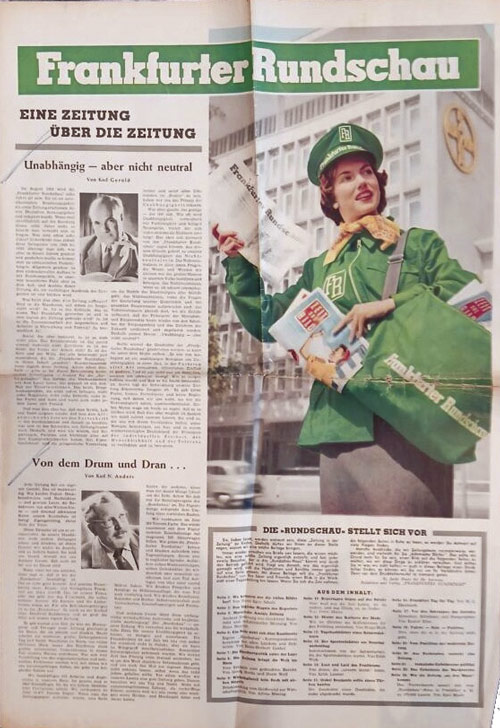
In 1995, to mark the 50th anniversary of the FR, Editor-in-Chief Roderich Reifenrath compiled 100 front pages of the newspaper (see Reifenrath, 1995) into a book and a special edition, a task that must have required leafing through every single issue of the Rundschau. The masthead from the mid-1950s states unequivocally: »Publisher and Editor-in-Chief: Karl Gerold. Publishing Director: Karl N. Anders. […] Managing Directors: Karl N. Anders and Karl Gerold.« And in 1955, Karl Anders appears prominently, with a portrait photo, as the author of an editorial titled »On the Ins and Outs,« which explains the printing company’s commercial success as a prerequisite for journalistic independence, on the cover of the supplement marking the tenth anniversary of the Frankfurter Rundschau; in the same size and layout as Karl Gerold with his lead story under the famous motto »Independent – but not neutral.« When the 100 front pages were published, this did not prompt anyone at the FR to conduct further research into the man who, alongside Gerold, was the most important figure at the newspaper at the time.
Another part of this history of suppression is that in 1997, the Rundschau published only a terse three-line obituary on the death of Karl Anders, and only did so after vehement pressure from his daughter. At the same time, a 50 percent discount was immediately offered for the obituary without hesitation, because according to the records – at least the accounting records – the deceased was listed as a former employee and had received a pension until his death.
In 2020/2021, on the occasion of the Frankfurter Rundschau’s coverage of the newspaper’s 75th anniversary, Ann Anders complained to the editorial board and a group of Rundschau editors that her father had once again not been mentioned. She had been informally raising this issue repeatedly for over 20 years. This time, she provided a great deal of background information in her correspondence. In 2021, the editorial board promised in several emails available to the authors »that this information and these insights would be taken into account in the future.«[9] But that has hardly happened.
Figure 3
Special supplement (January 1955) on the new Rundschau building, featuring editorials by Karl Gerold and Karl Anders
An attempt to speak with Editor-in-Chief Karin Dalka at the end of the event in June 2025 regarding the publication of Göpfert’s book on Karl Anders was rebuffed. She signaled through body language that she did not wish to speak with Alf Mayer, the event’s troublemaker, and ostentatiously turned away. She also did not respond to an offer sent via email. As recently as August 14, 2025, Ann Anders was informed by the board of the Gerold Foundation that »assistance in addressing your personal sensitivities regarding the recognition of your undoubtedly deserving father as a former employee of the Frankfurter Rundschau« did not fall within the foundation’s purpose.[10]
In the anniversary supplement Frankfurter Rundschau. 80 Years, published on September 11, 2025, a paragraph on Karl Anders was then inserted on page 12 – likely due to external pressure from researchers. There was not enough space for a photo. Quote: »Starting in 1953, Gerold had to share his influence at the publishing house with a man about whom nothing had been written in the FR’s history until then: Karl Anders. The FR generation of that time has shrouded this period in silence. Why? One can only speculate.«
By that point, the Rundschau should have known better. The editorial board had clear indications, evidence, and objections at its disposal; these included even a call by former Rundschau editor-in-chief Wolfgang Storz for an independent commission of historians to reassess the publication’s history. On July 1, 2025, the Frankfurt cultural magazine Strandgut published a two-page report on »Historical Distortion at the Rundschau.« The online magazine CulturMag featured further articles with additional documents (see Mayer, 2025a,b,c,d).
All of this was certainly read and taken note of at the FR and at the Gerold Foundation, which once owned the newspaper entirely and still owns ten percent of it today, insiders said. But they also reported that the motto was: »We’ll just sit this one out.«
The language of the paragraph that was ultimately inserted gives it away: there it is again, and still: the myth of the strong man of the Frankfurter Rundschau, who unfortunately had to share his influence a little. That same Karl Gerold who, in 1954, stood on the brink of ruin with his newspaper, without help or credit, and desperately sought a co-publisher.
7. Reasons and consequences and other gaps in
public information
The German Press Council, which was finally called upon in September 2025 due to the information gap based on 500 documents, recognized a violation of Section 2 of the Press Code, ruled on »Negligent presentation in the corporate history of a newspaper publisher,« and issued a reprimand. The Press Council’s decision was buried by the FR in the classic »time between the years,« namely on December 27, 2025, in the »Sorry« column, which is otherwise used to apologize for minor daily errors. Addressing an omission »in one’s own interest« – one that was not accidental but repeatedly disseminated without due diligence over the years – would look different. It is not a clear editorial correction. Nor does the FR appear to follow the practice of providing correction or amendment notices for errors or mistakes – a practice long standard at other newspapers. In any case, the passages in the FR’s online articles that were altered in response to external pressure contain no such notices.
With its censure (see German Press Council, Decision 0968/25/1-BA), the Press Council adhered to a rule that does not exist in its Press Code but would be important there because it would concretize the basic journalistic standard for publication. It could read, for example:
»It is contrary to journalistic decency and damages the reputation of the press not to publish accurate information of public interest (or, alternatively, of particular public interest) of which a media outlet (or, alternatively, an editorial office) has become aware.« (see Pöttker, 2013, p. 130)
The fact that the Press Council criticizes the omission of information of public interest as a breach of the duty of care diverges not only from a widespread view that leaves the selection of published – and thus also omitted – information solely to freedom of communication and, consequently, to the subjective preferences of editorial staff, publishing directors, publishers, etc. It holds communicators accountable – beyond the technically verifiable accuracy of what is publicly communicated – with regard to its importance, thereby pointing to the reprehensibility of gaps in public information.[11] Anyone who, during a soccer match, were to report accurately only on the home team’s goals would be guilty of violating the professional duty of completeness, relevance, or appropriateness (see Pöttker, 2025a, 188f.) – just as journalists who, in characterizing their society, would present only its failures and grievances or, as happened in the GDR, only its achievements. This also applies to the self-representation of a media organization and its history if it is to meet professional journalistic standards.
Gaps in public discourse are not solely related to the subjective likes and dislikes of communicators. In terms of effort and systematic patterns, general reasons rooted in socio-economic circumstances can also be identified (see Pöttker, 2025b). What reasons and motives can be assumed for the exclusion of Karl Anders from the history of the FR?
It stands to reason that this involves – similar to the tendency in sports journalism to report more on the successes of one’s own country’s athletes than on those of other nations – the fulfillment of a more or less conscious need for identification with one’s own nation or group, including one’s own media outlet. The memory of a figure of identification once elevated to a pedestal, such as Karl Gerold, satisfies this need, whereas the memory of their conflicts with an adversary like Karl Anders interferes with it. Stalin attempted to erase the memory of Trotsky by having his name removed from texts and even his likeness from photographs. For Stalin, keeping the memory of Trotsky alive among the Russian population put at risk their identification with the Soviet Union and, consequently, his own position of power as their figurehead. Similarly, for the FR, keeping the memory of Karl Anders alive would put at risk the identification of the staff and also of some readers with the »patron saint« Karl Gerold – and thus a part of the business.
The deliberate falsification of information is not the main ethical problem in journalism. Lies have short legs; they can usually be uncovered beyond a shadow of a doubt, proven, and exposed. Journalists and their backers in the media shy away from this. The main problem is omission, where circumstances related to the »public interest« – which are difficult to define precisely but clearly perceptible – would require reporting or making the information generally accessible. For this is – also because the omission, the silence, perpetuates itself (cf. Pöttker, 1999) – much harder to uncover and criticize. Also, because it can be justified, if necessary, by the fundamental right to freedom of communication – which includes the right not to communicate – violating the professional duty of completeness or relevance carries fewer risks than violating the duty of accuracy. Not »lying press,« but »gaps in the press« would be the term that both a realistic external critique of journalism and a realistic self-understanding within the profession would have to take seriously.
To regard the omission of information of public interest as a breach of the duty of care – as the Press Council once did in this case – or, more explicitly, to classify it as inaccurate or false reporting – as seems justifiable from an epistemological perspective when designing procedural rules – upholds the principle of evidence. Journalistic quality rests on this principle as the central basis for publishing decisions. Criticism of the omission of relevant information defends the culture of enlightenment, which is increasingly threatened in everyday life and politics by the spread of online communication on digital platforms, »fake news,« and artificial intelligence (see Pöttker, 2025c). If the issue is no longer whether public statements are true, but only how they are perceived and whom they supposedly benefit or harm, the journalistic profession, with its verification of information, becomes superfluous. It would also mark the end of a democratic culture that, despite all its shortcomings, is the most important prerequisite for coping reasonably well with the world as it is and for meeting its challenges with a chance of success.
It took the historical mills at the Frankfurter Rundschau 74 years to remember co-founder Emil Carlebach again. By 2031, it would be time for this newspaper to make amends to Karl Anders and his descendants. But that seems uncertain in light of the crumbling of the culture – which emerged only with the Enlightenment and is also liable to be lost again – that revolves around accurate information and sound reasoning. We have grown accustomed to attributing anti-democratic activities to figures like Donald Trump and others associated with right-wing populism and extremism. But the gap in public discourse surrounding Karl Anders shows that even the left-liberal journalism of which the Frankfurter Rundschau is so proud cannot consider itself immune to this.
About the authors
Alf Mayer, born in 1952, learned the ropes of journalism at the Augsburger Allgemeine and was then, until 1985, one of two editors of the media magazine medium, published by the Gemeinschaftswerk der Evangelischen Publizistik (GEP); he worked with Alexander Kluge and Edgar Reitz, served on numerous film and literature juries, was culture editor at Deutsche Lufthansa, copy editor at Manufactum, editor-in-chief at Horizont and at IG Metall, translated six American novels, saved the now regularly award-winning CasaBlanca Arthouse cinema in Bad Soden am Taunus, and is the editor of the online magazine CulturMag. Regarding the case of Karl Anders at the Frankfurter Rundschau, he conducted extensive research in various archives and held numerous interviews, including with Karl Anders himself and his daughter. Contact: culturmag@gmx.de
Horst Pöttker, born in 1944, earned his doctorate in 1978 from the University of Basel with a dissertation titled On the Democratic Quality of the Content of National West German Daily Newspapers, in which he demonstrated that the Frankfurter Rundschau, under the direction of Karl Gerold, exhibited fewer ethnocentric tendencies than newspapers published by Axel Springer. From 1985 to 1996, he served as editor-in-chief of the media journal medium at the Gemeinschaftswerk der Evangelischen Publizistik (GEP); after completing his habilitation in 1995 at the University of Siegen, he was appointed professor of the theory and practice of journalism at the University of Dortmund in 1996. At that time, he wrote articles on local history for the Bad Homburg section of the FR; in 2018, he co-founded the online journal Journalistik / Journalism Research with colleagues. Contact: horst.poettker@tu-dortmund.de
References
Anders, Karl (1948). Im Nürnberger Irrgarten. Nest-Verlag.
Deutscher Presserat (2025, December 11). Sorgfaltswidrige Darstellung in der Unternehmenschronik eines Zeitungsverlags (Aktenzeichen 0968/25/1-BA). https://www.presserat.de/entscheidungen-finden-details/0968-25-1-ba-0.html
Göpfert, Claus-Jürgen (2025). Zeitung im Kampf. 80 Jahre Frankfurter Rundschau oder: Niedergang des linksliberalen Journalismus? VSA.
Mayer, Alf (1989). Mit der Zeit. Politik und Kriminalliteratur. Karl Anders und seine »Krähen-Bücher«. Porträt eines Pioniers. In Martin Compart & Thomas Wörtche (Eds.), Jahrbuch der Kriminalliteratur 1989 (pp. 113–144). Bastei-Lübbe.
Mayer, Alf (2000). Tausendfüssler. Vergessene Verlage (6): Nest-Verlag. Börsenblatt für den Deutschen Buchhandel, 167(4/14), 21–24.
Mayer, Alf (2017, March 15). Karl Anders – »Krähen-Meister«. Anarchist, Kommunist, Widerstandskämpfer, Sozialist… Ein Salut zum 20. Todestag. CulturMag. https://culturmag.de/crimemag/essay-alf-mayer-karl-anders-kraehen-meister/9963
Mayer, Alf (2025a, September 8). Auch du, Brutus! Wie es zur Entsorgung von Karl Anders kam. 1. August 1957 – Der Tag, an dem sich die Frankfurter Rundschau eine historische Last aufbürdete. Warum der Widerstandskämpfer und Verleger Karl Anders von seinem Partner Karl Gerold bei der Frankfurter Rundschau entfernt wurde, dann über Jahrzehnte totgeschwiegen wird, und warum die Karl-Gerold-Stiftung eine Unabhängige Historikerkommission braucht. CulturMag. https://culturmag.de/allgemein/auch-du-brutus-wie-es-zur-entsorgung-von-karl-anders-kam/174768
Mayer, Alf (2025b, July 1). Buch mit Leerstellen. Rohrkrepierer – Im eigenen Glashaus sollten die Fakten schon stimmen. CulturMag. https://culturmag.de/crimemag/buch-mit-leerstellen-80-jahre-frankfurter-rundschau/173435
Mayer, Alf (2025c, July 1). Warum wird Karl Anders bei der FR totgeschwiegen? CulturMag. https://culturmag.de/crimemag/alf-mayer-warum-wird-karl-anders-bei-der-fr-totgeschwiegen/173163
Mayer, Alf (2025d, October 1). Der »starke Mann« war gar nicht mehr kreditwürdig. Warum der Widerstandskämpfer Karl Anders bei der »Frankfurter Rundschau« totgeschwiegen wird (Teil 7). CulturMag. https://culturmag.de/allgemein/der-starke-mann-war-gar-nicht-mehr-kreditwuerdig/174741
Mayer, Alf (2025, July 1). Überblick »Karl Anders – biografischer Schnelldurchlauf«. CulturMag. https://culturmag.de/crimemag/biografischer-schnelldurchlauf-karl-anders/173603
Meng, Richard, & Kaspar, Thomas (Eds.) (2021). Haltung zählt. Anspruch und Geschichte der Frankfurter Rundschau. Edition 7.
Pflüger, Andreas (2021). Ritchie Girl. Suhrkamp.
Pöttker, Horst (1999). Initiative Nachrichtenaufklärung: Zwölf Thesen über das öffentliche (Ver-)Schweigen. In Peter Ludes & Helmut Schanze (Eds.), Medienwissenschaften und Medienwertung (pp. 161–169). Westdeutscher Verlag.
Pöttker, Horst (2013). Öffentlichkeit oder Moral? Über den inneren Widerspruch des journalistischen Berufsethos am Beispiel des deutschen Pressekodex. Publizistik, 58, 121–139.
Pöttker, Horst (2025a). Zukunftsperspektiven. Architekturjournalismus als Reservoir journalistischer Qualitäten. In Andreas Schümchen & Patrycja Muc (Eds.), Architekturjournalismus. Über Bauen und Planen berichten (pp. 183–204). transcript.
Pöttker, Horst (2025b). Geheim, verdrängt, unbekannt. Lücken von Öffentlichkeit: Worüber Medien gern schweigen – und warum sie das tun. In Carsten Brosda & Daniel Müller (Eds.), Beruf zur Öffentlichkeit. Ausgewählte Schriften zu Theorie, Ethik, Geschichte und Perspektive des Journalismus (pp. 378–408). Herbert von Halem.
Pöttker, Horst (2025c). Realität – Fiktionalität – Virtualität. Erkennbarkeit als journalistisches Problem aus historischer Sicht. In Carsten Brosda & Daniel Müller (Eds.), Beruf zur Öffentlichkeit. Ausgewählte Schriften zu Theorie, Ethik, Geschichte und Perspektive des Journalismus (pp. 345–354). Herbert von Halem.
Reifenrath, Roderich (Ed.). (1995). 50 Jahre Frankfurter Rundschau. 100 Titelseiten dokumentieren Zeitgeschichte.
Reifenrath, Roderich (2003). Die Blattmacher. Aus der Praxis der Journalisten. Nest-Verlag.
Reifenrath, Roderich (2015, July 31). Karl Gerold legte das Fundament der FR. Frankfurter Rundschau. https://www.fr.de/ueber-uns/unabhaengig-aber-nicht-neutral-11151596.html
Rössler, Patrick (2007). Anders denken. Krähen-Krimis und Zeitprobleme: der Nest-Verlag von Karl Anders. Begleitpublikation zur Ausstellung anlässlich des 100. Geburtstags von Karl Anders. Sutton.
Sering, Paul (1946). Jenseits des Kapitalismus. Ein Beitrag zur sozialistischen Neuorientierung. Nest-Verlag.
Storz, Wolfgang (2025, August 1). Stürzt bei der FR auch noch der Säulenheilige? Bruchstücke. https://bruchstuecke.info/2025/08/01/stuerzt-bei-der-fr-auch-noch-der-saeulenheilige/
Valenta, Reinhard (2023, August 12). Spektakuläre Flucht mit Fragezeichen. Südkurier. https://www.suedkurier.de/region/hochrhein/wehr/spektakulaere-flucht-mit-fragezeichen;art372624,11677619
Wir waren Antifaschisten. Ex-Chefredakteur Roderich Reifenrath über seine Erfahrungen mit Karl Gerold und den Journalismus der frühen Jahre. (2021). In Richard Meng & Thomas Kaspar (Eds.), Haltung zählt: Anspruch und Geschichte der Frankfurter Rundschau (pp. 45–53). Edition 7.
Footnotes
1 The Frankfurter Rundschau is a national, left-liberal or social-liberal daily newspaper. It has traditionally been known for its progressive, socially critical journalism, with a focus on politics, culture, and social debates. Since 2018, Zeitungsholding Hessen – which is backed by the Ippen Group – has held a majority stake in the FR.
2 At receptions or joint appearances with Karl Gerold, it often happened that Karl Anders was asked about his past or that references were made to it. For example: »I heard your voice on BBC Radio.«
3 The quote is a paraphrase from Valenta, »Spectacular Escape with a Question Mark«; see also Chapter 4 – Gerold had been able to retain his citizenship precisely because he had not participated in the agitation … The ban imposed by the law on the revocation of German citizenship, enacted on July 14, 1933, affected Anders just as it did all the other »enemy broadcaster« voices; a total of 39,000 Germans appeared on one of the expatriation lists published in the Reichsanzeiger during the Nazi era. This also included all prominent opponents of National Socialism who managed to flee abroad – such as Bertolt Brecht, Thomas Mann, and Hannah Arendt.
4 See also Karl Anders’s speech in memory of his friend »Rix,« which was made available digitally by CulturMag magazine in July 2025. (Contemporary document by Karl Anders: Speech for Richard »Rix« Löwenthal, CulturMag, July 1, 2025.), https://culturmag.de/crimemag/karl-anders-rede-fuer-richard-rix-loewenthal/173441
5 Karl Gerold’s ostracism had already targeted another clear anti-fascist before Anders: the communist Emil Carlebach, whose seat on the FR editorial board Gerold then took in 1946. According to features editor Wolfram Schütte, Rundschau editors were prohibited from associating with Carlebach during Gerold’s tenure; FR editors were not even supposed to attend Carlebach’s events. It was not until 2020 that the Frankfurter Rundschau reported on Carlebach as a form of reparation. According to Göpfert (see Göpfert, 2025, pp. 12ff.), as well as other sources, Gerold’s condition for joining the FR was reportedly that communist influence at the newspaper must be curtailed. He presented himself to the Americans colloquially as a »communist-eater.«
6 https://de.wikipedia.org/wiki/Karl_Gerold, May 18, 2026.
7 The PDF version is available here: https://www.fr.de/content/fr/downloads/pdf/FR80.pdf
8 See the review by Alf Mayer, 2025b.
9 The emails are available.
10 The email dated August 14, 2025 is available.
11 The German Federal Court of Justice recently issued a landmark ruling on this matter: Anyone who reports on a person in a defamatory manner while deliberately omitting known exculpatory circumstances is acting as if they had told a lie – even if each piece of information reported is true in and of itself. Strictly speaking, the ruling does not apply to the FR’s silence regarding Karl Anders, because in this case there is simply no report about the person at all. However, it points in the relevant direction, as it deems the omission of important information to be reprehensible and thus emphasizes the value of completeness as a professional ethical standard that transcends subjective freedom of choice.
About this article
Copyright
This article is distributed under Creative Commons Atrribution 4.0 International (CC BY 4.0). You are free to share and redistribute the material in any medium or format. The licensor cannot revoke these freedoms as long as you follow the license terms. You must however give appropriate credit, provide a link to the license, and indicate if changes were made. You may do so in any reasonable manner, but not in any way that suggests the licensor endorses you or your use. You may not apply legal terms or technological measures that legally restrict others from doing anything the license permits. More Information under https://creativecommons.org/licenses/by/4.0/deed.en.
Citation
Alf Mayer; Horst Pöttker: The case of Karl Anders and the Frankfurter Rundschau. How a publisher is ›forgotten‹. In: Journalism Research, Vol. 9 (2), 2026, pp. 89-108. DOI: 10.1453/2569-152X-22026-16216-en
ISSN
2569-152X
DOI
https://doi.org/10.1453/2569-152X-22026-16216-en
First published online
August 2026